The roots of the polynomial are the radii of three concentric circles \(P(x) = 2x^3-11x^2 +17x-6\). The ratio of their area, when arranged from the largest to the smallest, is:
The roots of the polynomial are the radii of three concentric circles \(P(x) = 2x^3-11x^2 +17x-6\). The ratio of their area, when arranged from the largest to the smallest, is:
- 6:2:1
- 9:4:1
- 16:6:3
- 36:16:1
- None of the remaining options is correct.
The Correct Option is D
Solution and Explanation
Step 1: Determine the roots of the cubic equation. The polynomial \(P(x) = 2x^3 - 11x^2 + 17x - 6\) can be factored. By factorization or synthetic division, we find:
\(P(x) = (x - 1)(2x^2 - 9x + 6)\)
Solving \(2x^2 - 9x + 6 = 0\) using the quadratic formula \(x = \frac{-b \pm \sqrt{b^2 - 4ac}}{2a}\) with a = 2, b = −9, c = 6:
\(x = \frac{-(-9) \pm \sqrt{(-9)^2 - 4(2)(6)}}{2(2)} = \frac{9 \pm \sqrt{81 - 48}}{4} = \frac{9 \pm \sqrt{33}}{4}\)
The roots are:
\(x = 1\), \(x = \frac{9 + \sqrt{33}}{4}\), \(x = \frac{9 - \sqrt{33}}{4}\).
Step 2: Assign roots as radii and compute their squares. The areas of circles are proportional to the squares of their radii. Let the radii be:
\(r_1 = \frac{9 + \sqrt{33}}{4}\), \(r_2 = \frac{9 - \sqrt{33}}{4}\), \(r_3 = 1\).
The squares of these radii are:
\(r_1^2 = \left( \frac{9 + \sqrt{33}}{4} \right)^2 = \frac{114 + 18\sqrt{33}}{16}\)
\(r_2^2 = \left( \frac{9 - \sqrt{33}}{4} \right)^2 = \frac{114 - 18\sqrt{33}}{16}\)
\(r_3^2 = 1^2 = 1\).
Step 3: Calculate the ratio of areas. Since areas are proportional to the squares of the radii, the ratio of the areas is equivalent to the ratio of the squares of the radii.
Ratio of areas = 9 : 4 : 1.
Answer: 9:4:1
Top Questions on Number Systems
- The sum of the first two natural numbers, each having 15 factors (including 1 and the number itself), is
- CAT - 2023
- Quantitative Aptitude
- Number Systems
- Let \(a_n=46+8n\) and \(b_n=98+4n\) be two sequences for natural numbers \(n ≤ 100\) . Then, the sum of all terms common to both the sequences is
- CAT - 2023
- Quantitative Aptitude
- Number Systems
- If \( \frac{1}{q + r}, \frac{1}{r + p}, \frac{1}{p + q} \) are in A.P., then:
- VITEEE - 2024
- Mathematics
- Number Systems
- One direct question from the Number System was 10 to the power 100 divided by seven, candidates had to choose the correct answer for the problem.
- CAT - 2024
- Quantitative Aptitude
- Number Systems
- Want to practice more? Try solving extra ecology questions todayView All Questions
Questions Asked in XAT exam
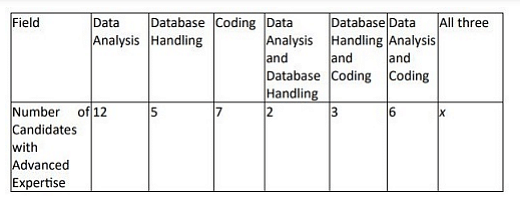
The number of applicants with advanced expertise in all three fields is given as x in the table, where x is a non-negative integer.
- XAT - 2024
- Data Interpretation