A king has distributed all his rare jewels in three boxes. The first box contains 1/3 of the rare jewels, while the second box contains k/5 of the rare jewels, for some positive integer value of k. The third box contains 66 rare jewels.
How many rare jewels does the king have?
How many rare jewels does the king have?
- 990
- 660
- 240
- 1080
- Cannot be determined uniquely from the given information.
The Correct Option is A
Solution and Explanation
Step 1: Define the total number of jewels. Let N represent the total number of jewels. Based on the problem statement:
Jewels in box 1 = $\frac{1}{3}N$, Jewels in box 2 = $\frac{k}{5}N$, Jewels in box 3 = 66.
The total number of jewels is expressed as:
N = $\frac{1}{3}N$ + $\frac{k}{5}N$ + 66.
Step 2: Simplify the equation. Rearrange the terms:
N − $\frac{1}{3}N$ − $\frac{k}{5}N$ = 66.
Combine like terms:
$\left( 1 - \frac{1}{3} - \frac{k}{5} \right)N$ = 66.
Simplify the coefficients:
$\left( \frac{3}{3} - \frac{1}{3} - \frac{k}{5} \right)N$ = 66 = =\(>\) $\left( \frac{2}{3} - \frac{k}{5} \right)N$ = 66.
Step 3: Solve for k. Given that k is a positive integer, test values such that $\frac{2}{3} - \frac{k}{5}<0$. Let k = 2:
$\frac{2}{3} - \frac{2}{5} = \frac{10}{15} - \frac{6}{15} = \frac{4}{15}$
Substitute this value into the equation:
$\frac{4}{15}N$ = 66 = =\(>\) N = $\frac{66 \times 15}{4}$ = 990 jewels.
Answer: 990
Top Questions on Number Systems
- The sum of the first two natural numbers, each having 15 factors (including 1 and the number itself), is
- CAT - 2023
- Quantitative Aptitude
- Number Systems
- Let \(a_n=46+8n\) and \(b_n=98+4n\) be two sequences for natural numbers \(n ≤ 100\) . Then, the sum of all terms common to both the sequences is
- CAT - 2023
- Quantitative Aptitude
- Number Systems
- If \( \frac{1}{q + r}, \frac{1}{r + p}, \frac{1}{p + q} \) are in A.P., then:
- VITEEE - 2024
- Mathematics
- Number Systems
- One direct question from the Number System was 10 to the power 100 divided by seven, candidates had to choose the correct answer for the problem.
- CAT - 2024
- Quantitative Aptitude
- Number Systems
- Want to practice more? Try solving extra ecology questions todayView All Questions
Questions Asked in XAT exam
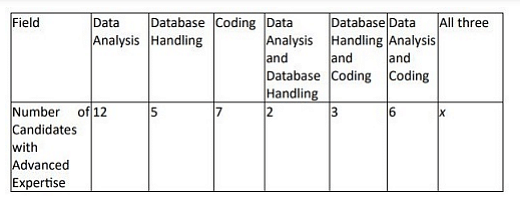
The number of applicants with advanced expertise in all three fields is given as x in the table, where x is a non-negative integer.
- XAT - 2024
- Data Interpretation