Question:medium
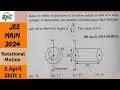
Ratio of radius of gyration of a hollow sphere to that of a solid cylinder of equal mass, for moment of Inertia about their diameter axis AB as shown in figure is \(\sqrt\frac{8} {x }\). The value of x is:

Ratio of radius of gyration of a hollow sphere to that of a solid cylinder of equal mass, for moment of Inertia about their diameter axis AB as shown in figure is \(\sqrt\frac{8} {x }\). The value of x is:
Updated On: Feb 18, 2026
- 34
- 17
- 67
- 51
Show Solution
The Correct Option is C
Solution and Explanation
The moment of inertia of a hollow sphere about its diameter axis is defined as: \( I_{\text{sphere}} = \frac{2}{3} MR^2 = M k_1^2 \), where \(k_1\) represents the hollow sphere's radius of gyration.
The moment of inertia of a solid cylinder about its diameter axis is expressed as: \( I_{\text{cylinder}} = \frac{1}{12} M(4R^2) + \frac{1}{4} MR^2 + M(2R)^2 = \frac{67}{12} MR^2 = M k_2^2 \).
The ratio of the radii of gyration is calculated as: \( \frac{k_1}{k_2} = \sqrt{\frac{\frac{2}{3}}{\frac{67}{12}}} = \sqrt{\frac{8}{67}} \).
Consequently, \(x\) equals 67.
Was this answer helpful?
7
Learn with videos:
Top Questions on Rotational motion
- Rate of cooling of a body is \(0.2^\circ \text{C/min}\) when excess temperature is \(20^\circ \text{C}\). The proportionality constant \( k \) is:
- MHT CET - 2024
- Physics
- Rotational motion
- A metal rod of length $ L = 0.8 \, \text{m} $ is rotating about its center with an angular velocity $ \omega = 10 \, \text{rad/s} $. What is the linear velocity of a point on the rod at a distance $ r = 0.4 \, \text{m} $ from the center?
- MHT CET - 2025
- Physics
- Rotational motion
- A thin spherical shell of radius \( 0.5 \, \text{m} \) and mass \( 2 \, \text{kg} \) is rotating about its axis of symmetry with an angular velocity of \( 10 \, \text{rad/s} \). What is its moment of inertia?
- MHT CET - 2025
- Physics
- Rotational motion
- A solid sphere of mass 2 kg and radius 0.5 m rolls without slipping down an inclined plane of height 3 m. What is its speed at the bottom? (Take \( g = 9.8\, \text{m/s}^2 \))
- BITSAT - 2025
- Physics
- Rotational motion
- Want to practice more? Try solving extra ecology questions todayView All Questions
