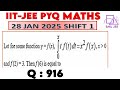
Let for some function \( y = f(x) \), \(\int_0^x t f(t) \, dt = x^2 f(x), x>0\) and \( f(2) = 3 \). Then \( f(6) \) is equal to:
Show Hint
- 3
- 1
- 6
- 2
The Correct Option is B
Solution and Explanation
To determine \( f(6) \), we first analyze the integral condition: \(\int_0^x t f(t) \, dt = x^2 f(x)\) for \(x > 0\). Differentiate both sides with respect to \(x\). Applying the Leibniz rule to the left side yields \(\frac{d}{dx}\left(\int_0^x tf(t) \, dt\right) = x f(x) + \int_0^x t \frac{d}{dx}f(t) \, dt\). Differentiating the right side gives \(\frac{d}{dx}(x^2 f(x)) = 2x f(x) + x^2 f'(x)\). Equating these derivatives results in \(x f(x) + \int_0^x t f'(t) \, dt = 2x f(x) + x^2 f'(x)\). By comparing, we see that \(\int_0^x t f'(t) \, dt\) must satisfy \(x f(x) = 2x f(x) + x^2 f'(x)\). This simplifies to \(0 = x f(x) + x^2 f'(x)\). Rearranging gives \(x f(x) + x^2 f'(x) = 0\). For \(x > 0\), we can divide by \(x\) to obtain \(f(x) + x f'(x) = 0\), which is the differential equation \(f'(x)/f(x) = -1/x\).
This differential equation is solved by separating variables: \(\frac{d}{dx}\ln|f(x)| = -\frac{1}{x}\). Integrating both sides yields \(\ln|f(x)| = -\ln|x| + C\), where \(C\) is the constant of integration. This simplifies to \(|f(x)| = \frac{e^C}{x}\). Thus, the function is of the form \(f(x) = \frac{k}{x}\), where \(k = e^C\) is a constant.
Given \( f(2) = 3 \), we substitute this into the function: \(f(2) = \frac{k}{2} = 3\), implying \(k = 6\). Therefore, the function is \(f(x) = \frac{6}{x}\).
Finally, we compute \( f(6) \): \(f(6) = \frac{6}{6} = 1\).
Learn with videos:
Top Questions on Differential Equations
- The order and degree of the differential equation: \[ \left[ 1 + \left(\frac{dy}{dx}\right)^2 \right]^3 = \frac{d^2y}{dx^2} \] respectively are:
- CBSE Class XII - 2024
- Mathematics
- Differential Equations
- The integrating factor of the differential equation \( x \frac{dy}{dx} - y = x^4 - 3x \) is:
- CBSE Class XII - 2024
- Mathematics
- Differential Equations
- The order and degree of the differential equation: \[ \left[ 1 + \left( \frac{dy}{dx} \right)^2 \right]^3 = \frac{d^2y}{dx^2}, \] respectively, are:
- CBSE Class XII - 2024
- Mathematics
- Differential Equations
- (a) Find: \[ \int \frac{x^2}{(x^2 + 4)(x^2 + 9)} \, dx. \]
- CBSE Class XII - 2024
- Mathematics
- Differential Equations
- Want to practice more? Try solving extra ecology questions todayView All Questions
