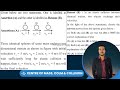
Given below are two statements, one is labelled as Assertion (A) and the other is labelled as Reason (R).
Three identical spheres of the same mass undergo one-dimensional motion as shown in the figure with initial velocities \( v_A = 5 \, \text{m/s}, v_B = 2 \, \text{m/s}, v_C = 4 \, \text{m/s} \). If we wait sufficiently long for elastic collision to happen, then \( v_A = 4 \, \text{m/s}, v_B = 2 \, \text{m/s}, v_C = 5 \, \text{m/s} \) will be the final velocities.
Reason (R): In an elastic collision between identical masses, two objects exchange their velocities.
In light of the above statements, choose the correct answer from the options given below:
Show Hint
In elastic collisions for identical masses, the velocities exchange. This is true when the objects collide directly in a one-dimensional motion.
Both (A) and (R) are true but (R) is NOT the correct explanation of (A)
(A) is true but (R) is false
Both (A) and (R) are true and (R) is the correct explanation of (A)
(A) is false but (R) is true
Show Solution
The Correct Option isD
Solution and Explanation
Step 1: For an elastic collision involving objects of identical mass, their velocities are exchanged.
Before the collision:
\[
v_A = 5 \, \text{m/s}, \, v_B = 2 \, \text{m/s}, \, v_C = 4 \, \text{m/s}
\]
After the collision:
\[
v_A' = 2 \, \text{m/s}, \, v_B' = 4 \, \text{m/s}, \, v_C' = 5 \, \text{m/s}
\]
Step 2: The assertion posits that after a prolonged duration, the velocities will stabilize at \( v_A = 4 \, \text{m/s}, v_B = 2 \, \text{m/s}, v_C = 5 \, \text{m/s} \). This aligns with the principle of elastic collision, where velocity exchange occurs.
Step 3: The reason also appears valid; in an elastic collision between masses of the same size, the objects' velocities do indeed interchange. However, the assertion describes a scenario where objects attain their terminal velocities after an extended period. Consequently, the reason does not accurately explain the assertion, rendering option (4) the correct choice.