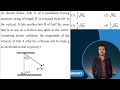
As shown below, bob A of a pendulum having a massless string of length \( R \) is released from 60° to the vertical. It hits another bob B of half the mass that is at rest on a frictionless table in the center. Assuming elastic collision, the magnitude of the velocity of bob A after the collision will be (take \( g \) as acceleration due to gravity):
Show Hint
In problems involving elastic collisions, use both conservation of energy and conservation of momentum to solve for unknown velocities.
The velocity of object $ A $ immediately before impacting object $ B $ is determined by:
$ u = \sqrt{2g \frac{R}{2}} = \sqrt{gR} $
Velocities post-collision: Let the velocities of objects $ A $ and $ B $ immediately after the collision be denoted as $ v_1 $ and $ v_2 $, respectively.
Momentum Conservation: The principle of conservation of momentum states that the total momentum before and after the collision remains constant. Therefore:
$ mu = mv_1 + \frac{m}{2}v_2 $
Simplified form:
$ 2v_1 + v_2 = 2u \quad \dots (i) $
Coefficient of Restitution ($ e $): Given that the coefficient of restitution is $ e = 1 $. The definition is:
$ e = \frac{v_2 - v_1}{u} $
With $ e = 1 $ substituted:
$ v_2 - v_1 = u \quad \dots (ii) $
Solving the system of equations (i) and (ii): From equation (ii), we derive:
$ v_2 = v_1 + u $
Substituting $ v_2 = v_1 + u $ into equation (i):
$ 2v_1 + (v_1 + u) = 2u $
After simplification:
$ 3v_1 + u = 2u $
$ 3v_1 = u $
$ v_1 = \frac{u}{3} $
Substituting $ u = \sqrt{gR} $:
$ v_1 = \frac{\sqrt{gR}}{3} $
Result: The velocity of object $ A $ immediately after the collision is: