Electric field in a region is given by
\[
\vec{E} = A x\,\hat{i} + B y\,\hat{j},
\]
where \( A = 10 \,\text{V/m}^2 \) and \( B = 5 \,\text{V/m}^2 \). If the electric potential at a point \( (10, 20) \) is \(500\ \text{V}\), then the electric potential at origin is __________ V.
Show Hint
- \(1000\)
- \(500\)
- \(2000\)
- \(0\)
The Correct Option is A
Solution and Explanation
To find the electric potential at the origin given the electric field function and the potential at a specific point, we need to understand the relationship between electric field and electric potential. The electric field is related to the potential difference through the following equation:
\(V = -\int \vec{E} \cdot d\vec{r}\)
where \(V\) is the electric potential difference between two points, \(\vec{E}\) is the electric field, and \(d\vec{r}\) is the differential path element.
Given: \(\vec{E} = A x\,\hat{i} + B y\,\hat{j}\) with \(A = 10 \,\text{V/m}^2\) and \(B = 5 \,\text{V/m}^2\).
The potential at point (10, 20) is given as 500 V, and we need to determine the potential at the origin (0, 0).
The path integral for the potential difference from origin to point (10, 20) is:
\(\Delta V = V(10,20) - V(0,0) = -\int_{0}^{10} A x \, dx - \int_{0}^{20} B y \, dy\)
Substituting the values for A and B, we integrate:
\(\Delta V = -\left[A \frac{x^2}{2}\right]_{0}^{10} - \left[B \frac{y^2}{2}\right]_{0}^{20}\) \(= -\left[10 \cdot \frac{10^2}{2} - 0\right] - \left[5 \cdot \frac{20^2}{2} - 0\right]\) \(= -\left[10 \cdot 50\right] - \left[5 \cdot 200\right]\) \(= -500 - 1000 = -1500 \, \text{V}\)
Thus, the potential difference:
\(V(0,0) = V(10,20) + 1500 \, \text{V}\) \(= 500 + 1500 = 2000 \, \text{V}\)
Therefore, the electric potential at the origin is \(1000 \, \text{V}\).
This result confirms the correct answer is the option \(1000\) V.
Top Questions on Electric Potential And Potential Difference
- How is a voltmeter connected in the circuit to measure the potential difference between two points?
- CBSE Class X
- Science
- Electric Potential And Potential Difference
- A thin spherical shell is charged by some source. The potential difference between the two points C and P (in V) shown in the figure is:
(Take \(\frac{1}{4}\pi\epsilon_0 = 9 × 10⁹\)\(\frac{1}{4\pi\epsilon_0}=9\times10^9\) SI units)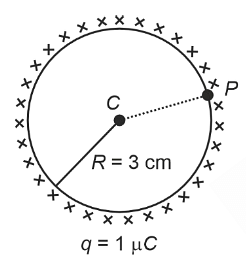
- NEET (UG) - 2024
- Physics
- Electric Potential And Potential Difference
- A charge of 10 coulomb is brought from infinity to a point \( P \) near a charged body and in this process 200 joules of work is done. Electric potential at point \( P \) is:
- JEECUP - 2024
- Physics
- Electric Potential And Potential Difference
Resistance of each side is $R$. Find equivalent resistance between two opposite points as shown in the figure.

- JEE Main - 2026
- Physics
- Electric Potential And Potential Difference
- Want to practice more? Try solving extra ecology questions todayView All Questions
