Question:medium
A thin spherical shell is charged by some source. The potential difference between the two points C and P (in V) shown in the figure is:
(Take \(\frac{1}{4}\pi\epsilon_0 = 9 × 10⁹\)\(\frac{1}{4\pi\epsilon_0}=9\times10^9\) SI units)
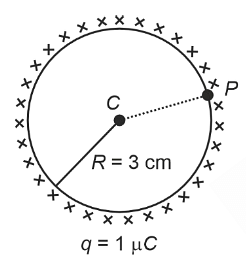
A thin spherical shell is charged by some source. The potential difference between the two points C and P (in V) shown in the figure is:
(Take \(\frac{1}{4}\pi\epsilon_0 = 9 × 10⁹\)\(\frac{1}{4\pi\epsilon_0}=9\times10^9\) SI units)
(Take \(\frac{1}{4}\pi\epsilon_0 = 9 × 10⁹\)\(\frac{1}{4\pi\epsilon_0}=9\times10^9\) SI units)
Updated On: Jan 13, 2026
- 3 × 10⁵
- 1 × 10⁵
- 0.5 × 10⁵
- Zero
Show Solution
The Correct Option is D
Solution and Explanation
To ascertain the potential difference between points \( C \) and \( P \) on a charged thin spherical shell, we examine potential characteristics within and external to the shell. For a thin spherical shell:
- Within the shell (any location inside its radius), the electric potential remains constant. This stems from the electric field being zero inside the shell, a consequence of symmetry and Gauss's law. Consequently, the potential difference between any two internal points is zero.
- External to the shell, the shell acts as a point charge situated at its center. The potential \( V \) at a distance \( r \) from the center is calculated as \( V = \frac{kQ}{r} \), where \( Q \) represents the total charge on the shell and \( k = 9 \times 10^9 \, \text{Nm}^2/\text{C}^2 \).
- If both points \( C \) and \( P \) are situated either inside the shell or at an identical radial distance from the center, the potential difference between them is zero.
Given that both points are located either within the shell or at the same radial distance, the potential difference is: Zero
Was this answer helpful?
3
Top Questions on Electric Potential And Potential Difference
- How is a voltmeter connected in the circuit to measure the potential difference between two points?
- CBSE Class X
- Science
- Electric Potential And Potential Difference
- A charge of 10 coulomb is brought from infinity to a point \( P \) near a charged body and in this process 200 joules of work is done. Electric potential at point \( P \) is:
- JEECUP - 2024
- Physics
- Electric Potential And Potential Difference
Resistance of each side is $R$. Find equivalent resistance between two opposite points as shown in the figure.

- JEE Main - 2026
- Physics
- Electric Potential And Potential Difference
- Electric field in a region is given by \[ \vec{E} = A x\,\hat{i} + B y\,\hat{j}, \] where \( A = 10 \,\text{V/m}^2 \) and \( B = 5 \,\text{V/m}^2 \). If the electric potential at a point \( (10, 20) \) is \(500\ \text{V}\), then the electric potential at origin is __________ V.
- JEE Main - 2026
- Physics
- Electric Potential And Potential Difference
- Want to practice more? Try solving extra ecology questions todayView All Questions

