Question:medium
As shown in the figure, a point charge $Q$ is placed at the centre of conducting spherical shell of inner radius $a$ and outer radius $b$. The electric field due to charge $Q$ in three different regions I, II and III is given by: (I: r $<$ a, II: $a $<$ r $<$ b$, III: $r$>$b)$
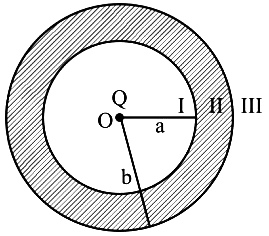
As shown in the figure, a point charge $Q$ is placed at the centre of conducting spherical shell of inner radius $a$ and outer radius $b$. The electric field due to charge $Q$ in three different regions I, II and III is given by: (I: r $<$ a, II: $a $<$ r $<$ b$, III: $r$>$b)$
Updated On: Apr 1, 2026
- $E_I=0, E_{I I}=0, E_{I I I}=0$
- $E_I \neq 0, E_{I I}=0, E_{I I}=0$
- $E_I=0, E_{I I}=0, E_{I I I} \neq 0$
- $E_I \neq 0, E_{I I}=0, E_{I I I} \neq 0$
Show Solution
The Correct Option is D
Solution and Explanation
Understanding the Setup:
- A point charge \( Q \) is placed at the center of a conducting spherical shell with inner radius \( a \) and outer radius \( b \). We need to determine the electric field \( E \) in three different regions:
- Region I: \( r < a \)
- Region II: \( a < r < b \)
- Region III: \( r > b \)
Region I (\( r < a \)):
- - According to Gauss's Law, the electric field \( E \) inside a conductor is determined by the enclosed charge. Here, the charge enclosed by a Gaussian surface within radius \( r < a \) is \( Q \). - Therefore, \( E \neq 0 \) inside this region. - The electric field is given by: \(E = \frac{Q}{4\pi\varepsilon_0r^2}\)
Region II (\( a < r < b \)):
- - In this region, we are inside the conducting shell but outside the center. - The nature of conductors is such that they will rearrange their charges to cancel out the internal electric field. - Therefore, \( E = 0 \) in this region.
Region III (\( r > b \)):
- - For \( r > b \), the shell can be treated as a point charge at the center because of the spherical symmetry. - The charge \( Q \) effectively influences this region. - The electric field is given by: \(E = \frac{Q}{4\pi\varepsilon_0r^2}\) - Thus, \( E \neq 0 \) here.
Conclusion:
- The correct answer is \( E_I \neq 0 \), \( E_{II} = 0 \), \( E_{III} \neq 0 \).
Was this answer helpful?
0
Top Questions on electrostatic potential and capacitance
- A 5-ohm resistor is connected to a 10 V battery. Calculate the current flowing through the resistor.
- MHT CET - 2025
- Physics
- electrostatic potential and capacitance
- Two point charges \( +4 \, \mu\text{C} \) and \( -2 \, \mu\text{C} \) are separated by a distance of 0.3 m in air. What is the magnitude of the electrostatic force between them?
- MHT CET - 2025
- Physics
- electrostatic potential and capacitance
- The electric field at a point in space is \( 2 \times 10^3 \, \text{N/C} \) and the potential at the same point is \( 100 \, \text{V} \). What is the potential energy of a charge of \( 5 \, \mu\text{C} \) placed at that point?
- MHT CET - 2025
- Physics
- electrostatic potential and capacitance
- The distance travelled by a particle starting from rest and moving with an acceleration \( \frac{4}{3} \) ms\(^{-2} \), in the third second is:
- BITSAT - 2024
- Physics
- electrostatic potential and capacitance
- Want to practice more? Try solving extra ecology questions todayView All Questions
