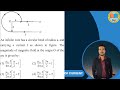
An infinite wire has a circular bend of radius \( a \), and carrying a current \( I \) as shown in the figure. The magnitude of the magnetic field at the origin \( O \) of the arc is given by:
Show Hint
For magnetic fields due to current-carrying wires, always break down the problem into simpler segments (arc, straight line) and use Biot-Savart's law to compute the contribution from each part.
For an arc of radius \( a \) spanning an angle of \( \frac{3\pi}{2} \), the magnetic field at the origin is given by: \[ B_1 = \frac{\mu_0 I}{4\pi a} \]
Step 2: Magnetic Field from the Straight Segment
For the straight segment of the wire, the magnetic field at the origin is calculated as: \[ B_2 = \frac{\mu_0 I}{4\pi a} \left( \frac{3\pi}{2} \right) \]
Step 3: Magnetic Field from Other Segments
The magnetic field generated by the straight segments at the origin is zero: \[ B_3 = 0 \]
Step 4: Total Magnetic Field Calculation
The total magnetic field at the origin is the sum of the fields from all segments: \[ B = \frac{\mu_0 I}{4\pi a} \left( \frac{3\pi}{2} \right) \]