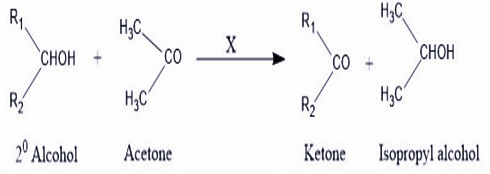
According to Oppenauer Oxidation reaction, oxidation of secondary alcohol to ketone by reagent (X) in acetone takes place, what is "X" :
Show Hint
The Oppenauer oxidation uses Aluminium t-butoxide as a reagent to selectively oxidize secondary alcohols to ketones. It is a mild oxidation method that avoids overoxidation.
Oppenauer oxidation works through a six-membered cyclic transition state in which a hydride moves directly from the alcohol substrate to the carbonyl carbon of a sacrificial ketone, and only an aluminium alkoxide catalyst can set up this transition state.
Aluminium Hydroxide: This compound lacks the alkoxide (OR) groups that are needed to first bind the substrate alcohol and form the mixed alkoxide intermediate central to this mechanism.
Amalgamated Zinc and Conc. HCl: This pairing is the classic Clemmensen reagent for reducing carbonyls to methylene groups, a reduction, not an oxidation, so its mechanism has nothing in common with the Oppenauer process.
Conc. \(H_2SO_4\): This strong acid catalyses reactions that go through carbocation or protonated intermediates, such as dehydration, and has no capacity to mediate a hydride transfer between an alcohol and acetone.
Aluminium t-butoxide: This aluminium alkoxide first exchanges its t-butoxide ligand for the substrate secondary alcohol, forming an aluminium-bound alkoxide. A hydride from this alkoxide's carbon is then transferred through a cyclic transition state to the carbonyl carbon of acetone, oxidising the substrate to a ketone while acetone is reduced to isopropanol. This is exactly the aluminium t-butoxide catalysed mechanism the Oppenauer oxidation is named for.
Since only an aluminium alkoxide can form the mixed alkoxide intermediate and carry out the hydride shift, the correct answer is Aluminium t-butoxide.