Understanding the Question:
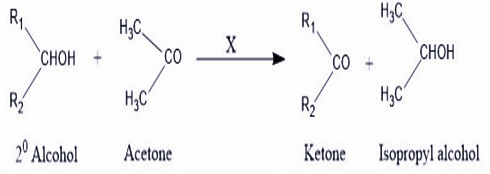
The question asks for reagent X, the catalyst that drives Oppenauer oxidation of a secondary alcohol to a ketone using acetone as the hydride acceptor.
Key Concept:
Oppenauer oxidation needs a metal alkoxide catalyst to first bind the alcohol substrate, then pass a hydride from that alcohol to acetone through a cyclic transition state, a mechanism specific to aluminium alkoxides.
Checking Each Option:
Aluminium hydroxide is a simple base that cannot form the alkoxide complex this hydride-transfer mechanism needs.
Amalgamated zinc with concentrated HCl belongs to Clemmensen reduction, which removes a carbonyl group rather than creating one, the reverse of what is asked here.
Concentrated \(H_2SO_4\) acts as an acid catalyst for reactions like esterification and dehydration, not for hydride-transfer oxidation.
Aluminium t-butoxide forms an aluminium alkoxide with the substrate alcohol and shuttles a hydride to acetone through a six-membered transition state, oxidizing the alcohol to the ketone while acetone becomes isopropanol.
Final Answer:
Aluminium t-butoxide is reagent X in this Oppenauer oxidation.