ABCD is a rectangle where points C and D have coordinates (−2, 0) and (2, 0), respectively. If the area of the rectangle is 24, what is the best way to describe the equation of the line AB?
Show Hint
- y = 3
- y = 6
- y = −3
- y = −6
The Correct Option is A
Solution and Explanation
Rectangle Geometry:
Points \(C\) and \(D\) are located on the x-axis at \((-2, 0)\) and \((2, 0)\) respectively. The length of side \(CD\), which serves as the rectangle's base, is calculated as:
\[ \text{Length of } CD = |2 - (-2)| = 4 \]
Rectangle Height Determination: The formula for the area of a rectangle is:
\[ \text{Area} = \text{Base} \times \text{Height} \]
Substituting the known values yields:
\[ 24 = 4 \times \text{Height} \]
Solving for the height gives:
\[ \text{Height} = \frac{24}{4} = 6 \]
Line \(AB\) Identification:
Given that the height is perpendicular to \(CD\) and the rectangle exhibits symmetry about the x-axis, lines \(AB\) and \(CD\) are parallel. Line \(AB\) is positioned 3 units above the x-axis (half of the total height). Therefore, the equation for \(AB\) is:
\[ y = 3 \]
Consequently, the most accurate representation of the equation for \(AB\) is \(y = 3\).
Top Questions on Geometry
- A rectangle \(ABCD\) has sides \(AB = 45 \, \text{cm}\) and \(BC = 26 \, \text{cm}\). Point \(E\) is the midpoint of side \(CD\). Find the radius of the incircle of the triangle \(\triangle AED\).
- CAT - 2024
- Quantitative Aptitude
- Geometry
- The coordinates of the foot of perpendicular from the point \( (2, 3) \) on the line \( y = 3x + 4 \) is given by:
- VITEEE - 2024
- Mathematics
- Geometry
- The points A(4, -2, 1), B(7, -4, 7), C(2, -5, 10), and D(-1, -3, 4) are the vertices of a:
- VITEEE - 2024
- Mathematics
- Geometry
- If A, B, C, D are the angles of a quadrilateral, then \[ \frac{\tan A + \tan B + \tan C + \tan D}{\cot A + \cot B + \cot C + \cot D} = \]
- VITEEE - 2024
- Mathematics
- Geometry
- Want to practice more? Try solving extra ecology questions todayView All Questions
Questions Asked in XAT exam
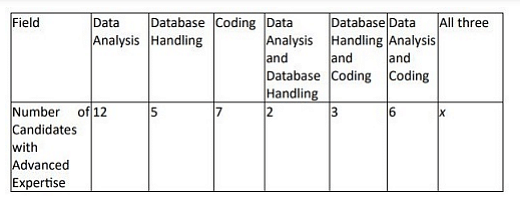
The number of applicants with advanced expertise in all three fields is given as x in the table, where x is a non-negative integer.
- XAT - 2024
- Data Interpretation