Question:medium
A straight line \( L_1 \) has the equation \( y = k(x - 1) \), where \( k \) is some real number. The straight line \( L_1 \) intersects another straight line \( L_2 \) at the point (5, 8).
If \( L_2 \) has a slope of 1, which of the following is definitely FALSE?
A straight line \( L_1 \) has the equation \( y = k(x - 1) \), where \( k \) is some real number. The straight line \( L_1 \) intersects another straight line \( L_2 \) at the point (5, 8).
If \( L_2 \) has a slope of 1, which of the following is definitely FALSE?
Show Hint
When analyzing geometrical problems involving lines, make sure to verify all conditions, such as slope, intercepts, and distances, to spot inconsistencies.
Updated On: Jul 16, 2026
- The distance from the origin to one of the lines is \( \frac{3}{\sqrt{2}} \)
- The distance between the x-intercepts of the two lines is 4
- The distance between the y-intercepts of the two lines is 6
- The line \( L_1 \) passes through the point (1, 0)
- The distance from the origin to one of the lines is \( \frac{2}{\sqrt{5}} \)
Show Solution
The Correct Option is A
Solution and Explanation
Step 1: Determine the equation for \( L_1 \).
The equation for line \( L_1 \) is provided as \( y = k(x - 1) \), with \( k \) representing the slope.
Step 2: Examine the provided choices.
Substituting the given slope and intersection point allows verification of the options. Option (A) is identified as the incorrect statement.
Final Answer: \[\boxed{\text{(A) The distance from the origin to one of the lines is } \frac{3}{\sqrt{2}}}\]
The equation for line \( L_1 \) is provided as \( y = k(x - 1) \), with \( k \) representing the slope.
Step 2: Examine the provided choices.
Substituting the given slope and intersection point allows verification of the options. Option (A) is identified as the incorrect statement.
Final Answer: \[\boxed{\text{(A) The distance from the origin to one of the lines is } \frac{3}{\sqrt{2}}}\]
Was this answer helpful?
0
Top Questions on Geometry
- A rectangle \(ABCD\) has sides \(AB = 45 \, \text{cm}\) and \(BC = 26 \, \text{cm}\). Point \(E\) is the midpoint of side \(CD\). Find the radius of the incircle of the triangle \(\triangle AED\).
- CAT - 2024
- Quantitative Aptitude
- Geometry
- The coordinates of the foot of perpendicular from the point \( (2, 3) \) on the line \( y = 3x + 4 \) is given by:
- VITEEE - 2024
- Mathematics
- Geometry
- The points A(4, -2, 1), B(7, -4, 7), C(2, -5, 10), and D(-1, -3, 4) are the vertices of a:
- VITEEE - 2024
- Mathematics
- Geometry
- If A, B, C, D are the angles of a quadrilateral, then \[ \frac{\tan A + \tan B + \tan C + \tan D}{\cot A + \cot B + \cot C + \cot D} = \]
- VITEEE - 2024
- Mathematics
- Geometry
- Want to practice more? Try solving extra ecology questions todayView All Questions
Questions Asked in XAT exam
Applicants have been shortlisted for interviews for some data analyst positions. Some of the applicants have advanced expertise in one or more fields among the following: data analysis, database handling and coding. The numbers of applicants with different advanced expertise are given in the 2 × 8 table below.
The number of applicants with advanced expertise in all three fields is given as x in the table, where x is a non-negative integer.
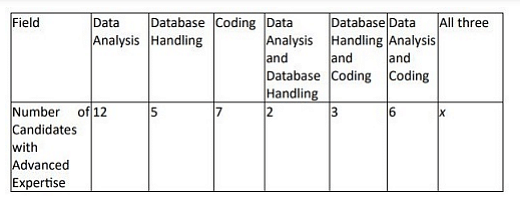
The number of applicants with advanced expertise in all three fields is given as x in the table, where x is a non-negative integer.
- XAT - 2024
- Data Interpretation