A wave on a string meets with another wave producing a node at . Then the equation of the unknown wave is:
- (A)
- (B)
- (C)
- (D)
The Correct Option is B
Solution and Explanation
To find the equation of the unknown wave, let's first understand the given situation clearly. We have a wave on a string represented by:
y = a \sin(\omega t - kx)
This wave meets another wave to produce a node at x = 0. A node indicates that the two waves are interfering destructively, meaning their displacements cancel each other out at that point.
In wave interference, for two waves to form a node, their displacements must be equal in magnitude but opposite in phase at the node point. The concept of superposition tells us that when two waves overlap, their amplitudes add together. Therefore, at the position of the node, the total displacement is zero.
Let's denote the unknown second wave as y_2. For destructive interference to occur at x = 0, we must have:
a \sin(\omega t - k \times 0) + y_2 = 0 \quad \Rightarrow \quad a \sin(\omega t) + y_2 = 0
This implies that:
y_2 = -a \sin(\omega t)
If we propose that the second wave is traveling in the positive x-direction, its equation would be of the form y_2 = \pm a \sin(\omega t + kx).
Choosing the proper sign to ensure destructive interference at x = 0, it must be:
y_2 = -a \sin(\omega t + kx)
This matches with option (B):
y = -a \sin(\omega t + kx)
Therefore, the equation of the unknown wave is correctly given by option (B).
Top Questions on Amperes circuital law
- A coil has a resistance of \( 30 \, \Omega \) and an inductive reactance of \( 20 \, \Omega \) at 50 Hz frequency. If an AC source of 200 V and 100 Hz is connected across the coil, then how much current will flow through the coil?
- MHT CET - 2024
- Physics
- Amperes circuital law
- In a series LCR circuit connected to an AC source, at resonance, the current is maximum because:
- MHT CET - 2024
- Physics
- Amperes circuital law
Consider the circuit shown :
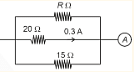 The ammeter reads 0.9 A. Value of R is
- JEE Main - 2024
- Physics
- Amperes circuital law
- A transistor is used in an amplifier circuit in common emitter mode. If the base current changes by 100μA, it brings a change of 10mA in collector current. If the load resistance is 2kΩ and input resistance is 1kΩ, the value of power gain is \(x×10^4\). The value of x is _______.
- JEE Main - 2022
- Physics
- Amperes circuital law
- Want to practice more? Try solving extra ecology questions todayView All Questions
