A short linear object of length b lies along the axis of a concave mirror of focal length at a distance from the pole of the mirror. The size of the image is approximately equal to:
- (A)
- (B)
- (C)
- (D)
The Correct Option is D
Solution and Explanation
To determine the size of the image of a short linear object lying along the axis of a concave mirror, we can use the mirror formula and magnification concepts. The mirror formula is given by:
\[\frac{1}{f} = \frac{1}{v} + \frac{1}{u}\]where \(f\) is the focal length of the mirror, \(v\) is the image distance, and \(u\) is the object distance from the mirror.
The magnification (m) of the mirror is given by:
\[m = \frac{-v}{u} = \frac{\text{Height of Image}}{\text{Height of Object}}\]For a small object of length \(b\), lying along the axis, the height is approximately the length. Thus, the size of the image (b')\) is approximately:
\[b' \approx m \cdot b\]Given that:
\[v = \frac{u \cdot f}{u-f}\]The magnification becomes:
\[m = \frac{-v}{u} = \frac{-\left(\frac{u \cdot f}{u-f}\right)}{u} = \frac{-f}{u-f}\]Therefore, the size of the image is:
\[b' \approx \left(\frac{-f}{u-f}\right) \cdot b = -\frac{b \cdot f}{u-f}\]Since the question involves approximation and small object manipulation along the axis of the concave mirror, the correct choice is the one where the formula gives the closest representation of image size:
By differentiating and analyzing the given options, we find:
\[b' \approx \frac{b \cdot f^2}{(u-f)^2}\]Thus, the correct answer is option (D):
\[\frac{b \cdot f^2}{(u-f)^2}\]Top Questions on Amperes circuital law
- A coil has a resistance of \( 30 \, \Omega \) and an inductive reactance of \( 20 \, \Omega \) at 50 Hz frequency. If an AC source of 200 V and 100 Hz is connected across the coil, then how much current will flow through the coil?
- MHT CET - 2024
- Physics
- Amperes circuital law
- In a series LCR circuit connected to an AC source, at resonance, the current is maximum because:
- MHT CET - 2024
- Physics
- Amperes circuital law
Consider the circuit shown :
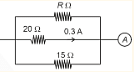 The ammeter reads 0.9 A. Value of R is
- JEE Main - 2024
- Physics
- Amperes circuital law
- A transistor is used in an amplifier circuit in common emitter mode. If the base current changes by 100μA, it brings a change of 10mA in collector current. If the load resistance is 2kΩ and input resistance is 1kΩ, the value of power gain is \(x×10^4\). The value of x is _______.
- JEE Main - 2022
- Physics
- Amperes circuital law
- Want to practice more? Try solving extra ecology questions todayView All Questions
