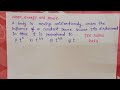
A body is moving unidirectionally under the influence of a constant power source. Its displacement in time t is proportional to :
- t2
- \(t^\frac{2}{3}\)
- \(t^\frac{3}{2}\)
- t
The Correct Option is C
Solution and Explanation
Assuming a constant power source influences the body's motion, the objective is to determine the relationship between displacement \( s \) and time \( t \).
Step 1: Power and Velocity Relationship
The constant power \( P \) supplied to the body is defined as:
\[ P = Fv, \]
where:
- \( F \) denotes the force acting on the body,
- \( v \) represents the body's velocity.
Applying Newton's second law, \( F = ma \) (where \( m \) is mass and \( a \) is acceleration), we get:
\[ P = mav. \]
Given that power is constant:
\[ P = mv \frac{dv}{dt}. \]
Step 2: Equation Integration
The equation is rearranged as:
\[ P \, dt = mv \, dv. \]
Integrating both sides yields:
\[ \int P \, dt = \int mv \, dv. \]
The result of the integration is:
\[ Pt = \frac{mv^2}{2} \implies v^2 = \frac{2Pt}{m}. \]
Taking the square root gives the velocity:
\[ v = \sqrt{\frac{2Pt}{m}}. \]
Step 3: Displacement Calculation
Velocity is defined as the rate of change of displacement with respect to time:
\[ v = \frac{ds}{dt} = \sqrt{\frac{2Pt}{m}}. \]
Rearranging and integrating:
\[ ds = \sqrt{\frac{2P}{m}} \, t^{1/2} \, dt. \]
Integrating both sides leads to:
\[ s \propto t^{3/2}. \]
Consequently, displacement \( s \) is directly proportional to \( t^{3/2} \).
Learn with videos:
Top Questions on Work and Energy
- A particle is placed at the point \( A \) of a frictionless track \( ABC \) as shown in the figure. It is gently pushed toward the right. The speed of the particle when it reaches the point \( B \) is: (Take \( g = 10 \, \text{m/s}^2 \)).

- JEE Main - 2024
- Physics
- Work and Energy
A heavy iron bar of weight 12 kg is having its one end on the ground and the other on the shoulder of a man. The rod makes an angle \(60^\circ\) with the horizontal, the weight experienced by the man is :
- JEE Main - 2024
- Physics
- Work and Energy
- The potential energy function (in joules) of a particle in a region of space is given as\[U = (2x^2 + 3y^3 + 2z).\]Here \( x \), \( y \), and \( z \) are in meters. The magnitude of the \( x \)-component of force (in newtons) acting on the particle at point \( P (1, 2, 3) \) m is:
- JEE Main - 2024
- Physics
- Work and Energy
- An artillery piece of mass \( M_1 \) fires a shell of mass \( M_2 \) horizontally. Instantaneously after the firing, the ratio of kinetic energy of the artillery and that of the shell is:
- JEE Main - 2024
- Physics
- Work and Energy
- Want to practice more? Try solving extra ecology questions todayView All Questions
