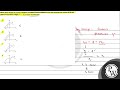
Which figure shows the correct variation of applied potential difference (\(V\)) with photoelectric current (\(I\)) at two different intensities of light (\(I_1 < I_2\)) of same wavelengths:


The Correct Option is C
Solution and Explanation
Photoelectric Effect and Current-Voltage Characteristics Explained:
The photoelectric current \( I \) is influenced by incident light intensity and applied potential difference \( V \).
Key observations include:
- For a constant frequency (or wavelength), the stopping potential \( V_0 \) is invariant, depending solely on incident light frequency, not intensity.
- Saturation current (peak current) is directly proportional to incident light intensity. Consequently, higher intensity light (e.g., \( I_2 \)) yields a greater saturation current than lower intensity light (e.g., \( I_1 \)).
Graph Selection Criteria:
Given the identical wavelength (or frequency) for both intensities, the stopping potential \( V_0 \) remains consistent for \( I_1 \) and \( I_2 \). However, due to \( I_2 > I_1 \), the saturation current for \( I_2 \) exceeds that for \( I_1 \).
Option (3) accurately depicts:
- Uniform stopping potential \( V_0 \) for both intensities.
- Saturation current for \( I_2 \) surpassing that for \( I_1 \), aligning with \( I_2 \)'s higher intensity.
Final Determination:
Option (3) is the correct graph, precisely illustrating the photoelectric current's behavior against applied potential for two distinct light intensities of the same wavelength.
Learn with videos:
Top Questions on Photoelectric Effect
- The difference between threshold wavelengths for two metal surfaces \( A \) and \( B \) having work functions \( \phi_A = 9 \, \text{eV} \) and \( \phi_B = 4.5 \, \text{eV} \) is: \[ \text{(Given: } h c = 1242 \, \text{eV nm)} \]
- MHT CET - 2024
- Physics
- Photoelectric Effect
- The maximum kinetic energy of the photoelectrons varies.
- MHT CET - 2024
- Physics
- Photoelectric Effect
- The work function of a metal is 2 eV. What is the threshold frequency for the photoelectric emission? (Take Planck's constant $ h = 6.63 \times 10^{-34} \, \text{Js} $, $ 1 \, \text{eV} = 1.6 \times 10^{-19} \, \text{J} $)
- BITSAT - 2025
- Physics
- Photoelectric Effect
- If \(\phi\) is the work function of photosensitive material in eV and light of wavelength of numerical value \(\lambda = \frac{hc}{e}\) metre, is incident on it with energy above its threshold value at an instant then the maximum kinetic energy of the photo-electron ejected by it at that instant (Take \(h\)-Planck’s constant, \(c\)-velocity of light in free space) is (in SI units):
- NEET (UG) - 2024
- Physics
- Photoelectric Effect
- Want to practice more? Try solving extra ecology questions todayView All Questions
