Question:medium
What is the area of the square, if four vertices lie on the circumference of a circle where the area of the circle is four times its diameter in magnitude?
What is the area of the square, if four vertices lie on the circumference of a circle where the area of the circle is four times its diameter in magnitude?
Updated On: Jan 13, 2026
- \(\frac{8}{\pi^2} sq.units\)
- \(\frac{16}{\pi^2} sq.units\)
- \(\frac{32}{\pi^2} sq.units\)
- \(\frac{64}{\pi^2} sq.units\)
- \(\frac{128}{\pi^2} sq.units\)
Show Solution
The Correct Option is
Solution and Explanation
The correct answer is option (E):
\(\frac{128}{\pi^2} sq.units\)
Let the area of the circle be A and its diameter be d. We are given that A = 4d.
We know that the area of a circle is given by the formula A = πr², where r is the radius.
The diameter d is twice the radius, so d = 2r.
We can substitute the expressions for A and d into the given equation A = 4d.
πr² = 4(2r)
πr² = 8r
Since r cannot be zero (otherwise, the circle wouldn't exist), we can divide both sides by r.
πr = 8
r = 8/π
Now, consider the square inscribed in the circle. The diagonal of the square is the diameter of the circle. Let s be the side length of the square.
By the Pythagorean theorem, the diagonal of the square, which is the diameter of the circle (d), is related to the side length s by d = s√2.
Since d = 2r, we can write 2r = s√2.
We found r = 8/π, so 2(8/π) = s√2
16/π = s√2
s = (16/π) / √2
s = 16 / (π√2)
The area of the square is s².
Area of the square = (16 / (π√2))²
Area of the square = (16²)/(π² * (√2)²)
Area of the square = 256 / (π² * 2)
Area of the square = 128 / π²
Therefore, the area of the square is 128/π² square units.
We know that the area of a circle is given by the formula A = πr², where r is the radius.
The diameter d is twice the radius, so d = 2r.
We can substitute the expressions for A and d into the given equation A = 4d.
πr² = 4(2r)
πr² = 8r
Since r cannot be zero (otherwise, the circle wouldn't exist), we can divide both sides by r.
πr = 8
r = 8/π
Now, consider the square inscribed in the circle. The diagonal of the square is the diameter of the circle. Let s be the side length of the square.
By the Pythagorean theorem, the diagonal of the square, which is the diameter of the circle (d), is related to the side length s by d = s√2.
Since d = 2r, we can write 2r = s√2.
We found r = 8/π, so 2(8/π) = s√2
16/π = s√2
s = (16/π) / √2
s = 16 / (π√2)
The area of the square is s².
Area of the square = (16 / (π√2))²
Area of the square = (16²)/(π² * (√2)²)
Area of the square = 256 / (π² * 2)
Area of the square = 128 / π²
Therefore, the area of the square is 128/π² square units.
Was this answer helpful?
0
Top Questions on Triangles, Circles & Quadrilaterals
- Let \(ΔABC\) be an isosceles triangle such that \(AB\) and \(AC\) are of equal length. \(AD\) is the altitude from \(A\) on \(BC\) and \(BE\) is the altitude from \(B\) on \(AC\) . If \(AD\) and \(BE\) intersect at \(O\) such that \(∠AOB =105\degree\) , then \(\frac{AD}{BE}\) equals
- CAT - 2023
- Quantitative Aptitude
- Triangles, Circles & Quadrilaterals
- A rectangle with the largest possible area is drawn inside a semicircle of radius 2 cm. Then, the ratio of the lengths of the largest to the smallest side of this rectangle is
- CAT - 2023
- Quantitative Aptitude
- Triangles, Circles & Quadrilaterals
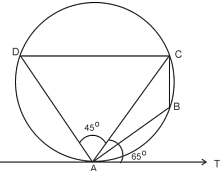
- In the given figure, if \(∠CAT = 65°\) and \(∠CAD = 45°\), what is the value of \(∠ACD?\) (Figure not drawn to scale)
- IBSAT
- Quantitative Aptitude
- Triangles, Circles & Quadrilaterals
- Gopi constructed a right-angled triangle. By modifying the dimensions of first triangle, he drew another triangle. The modifications are - the largest side is increased by 5 cm, the smallest side is doubled and the third side is increased by 50%. If the triangle formed with these new dimensions has equal angles, then what is the perimeter of the new triangle?
- IBSAT
- Quantitative Aptitude
- Triangles, Circles & Quadrilaterals
- Want to practice more? Try solving extra ecology questions todayView All Questions