Question:medium
Gopi constructed a right-angled triangle. By modifying the dimensions of first triangle, he drew another triangle. The modifications are - the largest side is increased by 5 cm, the smallest side is doubled and the third side is increased by 50%. If the triangle formed with these new dimensions has equal angles, then what is the perimeter of the new triangle?
Gopi constructed a right-angled triangle. By modifying the dimensions of first triangle, he drew another triangle. The modifications are - the largest side is increased by 5 cm, the smallest side is doubled and the third side is increased by 50%. If the triangle formed with these new dimensions has equal angles, then what is the perimeter of the new triangle?
Updated On: Jan 13, 2026
- 45 cm
- 60 cm
- 90 cm
- 120 cm
- 150 cm
Show Solution
The Correct Option is C
Solution and Explanation
The correct answer is option (C):
90 cm
Let's break down this geometry problem step by step.
We start with a right-angled triangle. A key property of a right-angled triangle is that it satisfies the Pythagorean theorem (a² + b² = c²). Let's call the sides of the original right-angled triangle a, b, and c, where c is the hypotenuse (the longest side). Assume a is the smallest side.
Now, Gopi modifies the triangle:
* The largest side (c) is increased by 5 cm: c becomes c + 5.
* The smallest side (a) is doubled: a becomes 2a.
* The third side (b) is increased by 50%: b becomes 1.5b (or b + 0.5b).
The new triangle has equal angles. A triangle with equal angles is an equilateral triangle. An equilateral triangle has all three sides equal. Therefore, in the modified triangle, all sides must be equal:
2a = 1.5b = c + 5
Since the original triangle was right-angled, we know a² + b² = c². However, we are now dealing with an equilateral triangle, so we can't directly use this. The fact the modified triangle is equilateral provides us the key.
Let's say each side of the equilateral triangle has length 'x'. Then:
2a = x
1.5b = x
c + 5 = x
From this, we can express a, b, and c in terms of x:
a = x/2
b = x/1.5 = (2/3)x
c = x - 5
Now, because the *original* triangle was a right triangle, we can apply the Pythagorean Theorem to the original sides, remembering these are derived from the equilateral triangle's sides:
a² + b² = c²
Substitute the expressions in terms of 'x':
(x/2)² + ((2/3)x)² = (x - 5)²
x²/4 + (4/9)x² = x² - 10x + 25
Multiplying through by 36 to eliminate fractions:
9x² + 16x² = 36x² - 360x + 900
25x² = 36x² - 360x + 900
0 = 11x² - 360x + 900
Now we need to solve this quadratic equation. We can factorize it.
0 = (x - 30)(11x - 30)
This gives us two possible solutions for x: x = 30 and x = 30/11. Since side lengths can’t be fractions of centimeters, the solution must be x = 30.
The perimeter of the new triangle (the equilateral triangle) is 3 * x = 3 * 30 = 90 cm.
We start with a right-angled triangle. A key property of a right-angled triangle is that it satisfies the Pythagorean theorem (a² + b² = c²). Let's call the sides of the original right-angled triangle a, b, and c, where c is the hypotenuse (the longest side). Assume a is the smallest side.
Now, Gopi modifies the triangle:
* The largest side (c) is increased by 5 cm: c becomes c + 5.
* The smallest side (a) is doubled: a becomes 2a.
* The third side (b) is increased by 50%: b becomes 1.5b (or b + 0.5b).
The new triangle has equal angles. A triangle with equal angles is an equilateral triangle. An equilateral triangle has all three sides equal. Therefore, in the modified triangle, all sides must be equal:
2a = 1.5b = c + 5
Since the original triangle was right-angled, we know a² + b² = c². However, we are now dealing with an equilateral triangle, so we can't directly use this. The fact the modified triangle is equilateral provides us the key.
Let's say each side of the equilateral triangle has length 'x'. Then:
2a = x
1.5b = x
c + 5 = x
From this, we can express a, b, and c in terms of x:
a = x/2
b = x/1.5 = (2/3)x
c = x - 5
Now, because the *original* triangle was a right triangle, we can apply the Pythagorean Theorem to the original sides, remembering these are derived from the equilateral triangle's sides:
a² + b² = c²
Substitute the expressions in terms of 'x':
(x/2)² + ((2/3)x)² = (x - 5)²
x²/4 + (4/9)x² = x² - 10x + 25
Multiplying through by 36 to eliminate fractions:
9x² + 16x² = 36x² - 360x + 900
25x² = 36x² - 360x + 900
0 = 11x² - 360x + 900
Now we need to solve this quadratic equation. We can factorize it.
0 = (x - 30)(11x - 30)
This gives us two possible solutions for x: x = 30 and x = 30/11. Since side lengths can’t be fractions of centimeters, the solution must be x = 30.
The perimeter of the new triangle (the equilateral triangle) is 3 * x = 3 * 30 = 90 cm.
Was this answer helpful?
0
Top Questions on Triangles, Circles & Quadrilaterals
- Let \(ΔABC\) be an isosceles triangle such that \(AB\) and \(AC\) are of equal length. \(AD\) is the altitude from \(A\) on \(BC\) and \(BE\) is the altitude from \(B\) on \(AC\) . If \(AD\) and \(BE\) intersect at \(O\) such that \(∠AOB =105\degree\) , then \(\frac{AD}{BE}\) equals
- CAT - 2023
- Quantitative Aptitude
- Triangles, Circles & Quadrilaterals
- A rectangle with the largest possible area is drawn inside a semicircle of radius 2 cm. Then, the ratio of the lengths of the largest to the smallest side of this rectangle is
- CAT - 2023
- Quantitative Aptitude
- Triangles, Circles & Quadrilaterals
- In the given figure, if \(∠CAT = 65°\) and \(∠CAD = 45°\), what is the value of \(∠ACD?\) (Figure not drawn to scale)
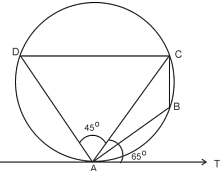
- IBSAT
- Quantitative Aptitude
- Triangles, Circles & Quadrilaterals
- What is the area of the square, if four vertices lie on the circumference of a circle where the area of the circle is four times its diameter in magnitude?
- IBSAT
- Quantitative Aptitude
- Triangles, Circles & Quadrilaterals
- Want to practice more? Try solving extra ecology questions todayView All Questions