Two wires PQ and QR carry equal currents I as shown in figure. One end of both the wires extends to infinity \(\angle PQR = \theta\). The magnitude of the magnetic field at O on the bisector of these two wires at a distance r from point Q is:
Show Hint
For semi-infinite wires, always use angle-based formula and resolve along symmetry axis.
Step 1: Understanding the Concept:
The magnetic field due to a finite wire segment is \( B = \frac{\mu_0 I}{4\pi d} (\sin \alpha_1 + \sin \alpha_2) \). Here, we have two semi-infinite wires. Point O is on the bisector. : Key Formula or Approach:
1. Perpendicular distance of O from either wire: \( d = r \sin(\theta/2) \).
2. Angles for semi-infinite wire: one end is at \( 90^\circ \) (infinity) and the other is at the angle subtended by the vertex. Step 2: Detailed Explanation:
For wire QR:
Distance \( d = r \sin(\theta/2) \).
Angle \( \alpha_1 = 90^\circ \) (infinite end).
Angle \( \alpha_2 \) corresponds to the projection. Looking at the geometry, the field at O due to one wire is:
\[ B_1 = \frac{\mu_0 I}{4\pi r \sin(\theta/2)} [\sin 90^\circ + \sin(90^\circ - \theta/2)] \]
\[ B_1 = \frac{\mu_0 I}{4\pi r \sin(\theta/2)} [1 + \cos(\theta/2)] \]
Total field \( B = 2 \times B_1 \):
\[ B = \frac{\mu_0 I}{2\pi r \sin(\theta/2)} [1 + \cos(\theta/2)] \] Step 3: Final Answer:
The magnitude of field is \( \frac{\mu_0 I}{2\pi r} \frac{[1 + \cos(\theta/2)]}{\sin(\theta/2)} \).

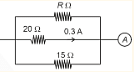 The ammeter reads 0.9 A. Value of R is