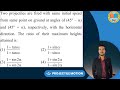
Two projectiles are fired with the same initial speed from the same point on the ground at angles of \( (45^\circ - \alpha) \) and \( (45^\circ + \alpha) \), respectively, with the horizontal direction. The ratio of their maximum heights attained is:
Show Hint
- \( \frac{1-\tan \alpha}{1+\tan \alpha} \)
- \( \frac{1-\sin 2\alpha}{1+\sin 2\alpha} \)
- \( \frac{1+\sin 2\alpha}{1-\sin 2\alpha} \)
- \( \frac{1+\sin \alpha}{1-\sin \alpha} \)
The Correct Option is B
Solution and Explanation
To determine the ratio of maximum heights achieved by two projectiles, we employ the formula for projectile maximum height: \(H = \frac{v_0^2 \sin^2 \theta}{2g}\), where \(v_0\) is initial velocity, \(\theta\) is projection angle, and \(g\) is gravitational acceleration.
Given projection angles of \( (45^\circ - \alpha) \) and \( (45^\circ + \alpha) \), the corresponding maximum heights, \(H_1\) and \(H_2\), are calculated as:
H1 = \( \frac{v_0^2 \sin^2 (45^\circ - \alpha)}{2g} \)
H2 = \( \frac{v_0^2 \sin^2 (45^\circ + \alpha)}{2g} \)
The ratio of these maximum heights is:
\(\frac{H_1}{H_2} = \frac{\sin^2 (45^\circ - \alpha)}{\sin^2 (45^\circ + \alpha)}\)
Applying the trigonometric identity \(\sin (A \pm B) = \sin A \cos B \pm \cos A \sin B\):
\(\sin (45^\circ - \alpha) = \sin 45^\circ \cos \alpha - \cos 45^\circ \sin \alpha = \frac{\sqrt{2}}{2}(\cos \alpha - \sin \alpha)\)
\(\sin (45^\circ + \alpha) = \sin 45^\circ \cos \alpha + \cos 45^\circ \sin \alpha = \frac{\sqrt{2}}{2}(\cos \alpha + \sin \alpha)\)
Substituting these into the ratio yields:
\(\frac{H_1}{H_2} = \left(\frac{\cos \alpha - \sin \alpha}{\cos \alpha + \sin \alpha}\right)^2\)
Dividing the numerator and denominator by \((\cos \alpha)^2\):
\(\frac{1 - \frac{2\sin \alpha \cos \alpha}{1+\sin^2 \alpha}}{1 + \frac{2\sin \alpha \cos \alpha}{1+\sin^2 \alpha}}\)
Utilizing the double angle identity \(\sin 2\alpha = 2\sin \alpha \cos \alpha\), the expression simplifies to:
\(\frac{1-\sin 2\alpha}{1+\sin 2\alpha}\)
Therefore, the ratio of the maximum heights is \( \frac{1-\sin 2\alpha}{1+\sin 2\alpha} \).
Learn with videos:
Top Questions on Projectile motion
- Two projectiles are projected at \( 30^\circ \) and \( 60^\circ \) with the horizontal with the same speed. The ratio of the maximum height attained by the two projectiles respectively is:
- MHT CET - 2024
- Physics
- Projectile motion
- The value of acceleration due to gravity at Earth's surface is \( 9.8 \, \text{m/s}^2 \). The altitude above its surface at which the acceleration due to gravity decreases to \( 4.9 \, \text{m/s}^2 \) is close to: (Radius of Earth \( R = 6.4 \times 10^6 \, \text{m} \))
- MHT CET - 2024
- Physics
- Projectile motion
A solid metallic cube having total surface area $ 24 \, \text{m}^2 $ is uniformly heated. If its temperature is increased by $ 10^\circ \, \text{C} $, calculate the increase in volume of the cube.
$ \text{(Given: } \alpha = 5.0 \times 10^{-4} \, \text{C}^{-1} \text{)} $- MHT CET - 2024
- Physics
- Projectile motion
- A large number of bullets are fired in all directions with the same speed \( v \). What is the maximum area on the ground on which these bullets will spread?
- MHT CET - 2024
- Physics
- Projectile motion
- Want to practice more? Try solving extra ecology questions todayView All Questions
