Two non-mixing liquids of densities $\rho$ and $ n\rho (n > 1)$ are put in a container. The height of each liquid is h. A solid cylinder of length L and density d is put in this container. The cylinder floats with its axis vertical and length $ pL (p < 1)$ in the denser liquid. The density d is equal to :
- $\{2 + (n + 1) p\} \rho$
- $\{2 + (n - 1) p\} \rho$
- $\{1 + (n - 1) p\} \rho$
- $\{1 + (n + 1) p\} \rho$
The Correct Option is C
Solution and Explanation
To find the density \( d \) of the solid cylinder, we need to analyze the buoyant forces acting on it. We consider the two layers of liquid with densities \( \rho \) and \( n\rho \) and their respective heights. The cylinder floats with a part submerged in the denser liquid, indicating equilibrium between buoyant force and gravitational force.
Let's apply the principle of flotation which states that the weight of the cylinder is equal to the weight of the liquid displaced.
- Volume Displacement Analysis: The cylinder has a total length \( L \) and is partly submerged as \( pL \) in the denser liquid \( n\rho \).
- Buoyant Force Equilibrium:
- The buoyant force from the lighter liquid is \( V_1 \rho g \), where \( V_1 \) is the submerged volume in this liquid.
- The buoyant force from the denser liquid is \( V_2 n\rho g \), where \( V_2 = A \times pL \), and \( A \) is the cross-sectional area of the cylinder.
- Weight of Cylinder: The weight of the cylinder can be expressed as \((A \times L \times d)g\).
- By the principle of buoyancy: \[ (V_1 \rho g) + (V_2 n\rho g) = (A \times L \times d)g \] Simplifying, this gives: \[ (\underbrace{AL(1-p)}_{V_1} \cdot \rho) + (ApL \cdot n\rho) = AL \cdot d \] \[ AL \rho + ApLn\rho - ApL\rho = ALd \] \[ AL \rho + ApL(n-1)\rho = ALd \]
- Solve for Density \( d \): Simplify further to find \( d \) in terms of \( \rho, n, \) and \( p \): \[ d = \left[1 + (n-1)p\right]\rho \]
Conclusion: The density \( d \) of the cylinder is \( \left\{1 + (n-1)p\right\}\rho \), matching with the given correct answer option. This takes into account the volume and density contributions from both layers of liquid.
Top Questions on Viscosity
- An air bubble of diameter 6 mm rises steadily through a solution of density 1750kg / m3 at the rate of 0.35 cm/s. The co-efficient of viscosity of the solution (neglect density of air) is ____Pas (given, g = 10ms-2)
- JEE Main - 2023
- Physics
- Viscosity
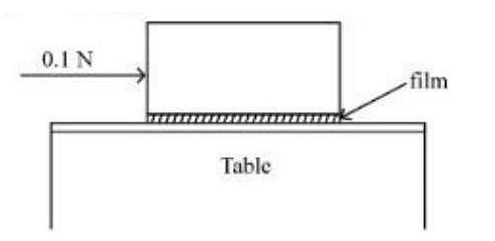
- A metal block of base area \(0.20 \,m^2\) is placed on a table, as shown in figure. A liquid film of thickness \(0.25\, mm\) is inserted between the block and the table. The block is pushed by a horizontal force of 0.1 N and moves with a constant speed. If the viscosity of the liquid is \(5.0×10^{−3}Pl\), the speed of block is ________ \(×10^{−3}m/s\)
- JEE Main - 2023
- Physics
- Viscosity
- The diameter of an air bubble which was initially 2 mm, rises steadily through a solution of density 1750 kg m–3 at the rate of 0.35 cms–1. The coefficient of viscosity of the solution is _______ poise (in nearest integer). (The density of air is negligible).
- JEE Main - 2022
- Physics
- Viscosity
A spherical ball is dropped in a long column of viscous liquid. The speed v of the ball as a function of time t may be best represented by

- BITSAT - 2010
- Physics
- Viscosity
- Want to practice more? Try solving extra ecology questions todayView All Questions

