Question:hard
Two drops of same radius are falling through air with steady velocity of $5~cms^{-1}$. If the two drops coalesce, the terminal velocity would be:
Two drops of same radius are falling through air with steady velocity of $5~cms^{-1}$. If the two drops coalesce, the terminal velocity would be:
Show Hint
Terminal velocity scales with the square of the radius; $v_t \propto r^2$.
Updated On: Oct 5, 2026
- $10~cms^{-1}$
- $5 \times 4^{1/3}~cms^{-1}$
- $5 \times 4^{2/3}~cms^{-1}$
- $2.5~cms^{-1}$
Show Solution
The Correct Option is B
Solution and Explanation
Step 1: Note the situation.
Two rain drops of the same radius fall at a steady terminal speed of 5 cm/s. They merge into one bigger drop, and we want the new terminal speed.
Step 2: Recall how terminal speed depends on size.
For a small sphere falling through air, the terminal velocity is proportional to the square of its radius: $v_t \propto r^{2}$. Bigger drops fall faster.
Step 3: Conserve volume when they merge.
The two drops join into one, so the total volume stays the same. Volume of a sphere is $\tfrac{4}{3}\pi r^{3}$, so $\tfrac{4}{3}\pi R^{3} = 2 \times \tfrac{4}{3}\pi r^{3}$.
Step 4: Find the new radius.
Cancelling gives $R^{3} = 2 r^{3}$, so $R = 2^{1/3} r$.
Step 5: Find the speed ratio.
Since speed goes as radius squared, $\dfrac{v_{new}}{v_{old}} = \left(\dfrac{R}{r}\right)^{2} = (2^{1/3})^{2} = 2^{2/3}$.
Step 6: Compute the new speed.
So $v_{new} = 5 \times 2^{2/3}$. Note $2^{2/3} = 4^{1/3}$, giving $v_{new} = 5 \times 4^{1/3}$ cm/s. \[ \boxed{5 \times 4^{1/3} \ \text{cm s}^{-1}} \]
Two rain drops of the same radius fall at a steady terminal speed of 5 cm/s. They merge into one bigger drop, and we want the new terminal speed.
Step 2: Recall how terminal speed depends on size.
For a small sphere falling through air, the terminal velocity is proportional to the square of its radius: $v_t \propto r^{2}$. Bigger drops fall faster.
Step 3: Conserve volume when they merge.
The two drops join into one, so the total volume stays the same. Volume of a sphere is $\tfrac{4}{3}\pi r^{3}$, so $\tfrac{4}{3}\pi R^{3} = 2 \times \tfrac{4}{3}\pi r^{3}$.
Step 4: Find the new radius.
Cancelling gives $R^{3} = 2 r^{3}$, so $R = 2^{1/3} r$.
Step 5: Find the speed ratio.
Since speed goes as radius squared, $\dfrac{v_{new}}{v_{old}} = \left(\dfrac{R}{r}\right)^{2} = (2^{1/3})^{2} = 2^{2/3}$.
Step 6: Compute the new speed.
So $v_{new} = 5 \times 2^{2/3}$. Note $2^{2/3} = 4^{1/3}$, giving $v_{new} = 5 \times 4^{1/3}$ cm/s. \[ \boxed{5 \times 4^{1/3} \ \text{cm s}^{-1}} \]
Was this answer helpful?
0
Top Questions on Viscosity
- An air bubble of diameter 6 mm rises steadily through a solution of density 1750kg / m3 at the rate of 0.35 cm/s. The co-efficient of viscosity of the solution (neglect density of air) is ____Pas (given, g = 10ms-2)
- JEE Main - 2023
- Physics
- Viscosity
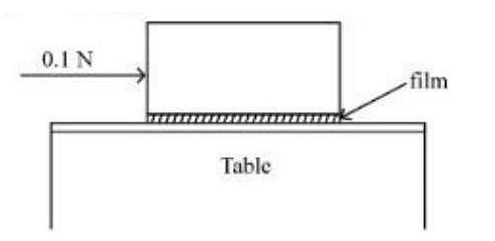
- A metal block of base area \(0.20 \,m^2\) is placed on a table, as shown in figure. A liquid film of thickness \(0.25\, mm\) is inserted between the block and the table. The block is pushed by a horizontal force of 0.1 N and moves with a constant speed. If the viscosity of the liquid is \(5.0×10^{−3}Pl\), the speed of block is ________ \(×10^{−3}m/s\)
- JEE Main - 2023
- Physics
- Viscosity
- The diameter of an air bubble which was initially 2 mm, rises steadily through a solution of density 1750 kg m–3 at the rate of 0.35 cms–1. The coefficient of viscosity of the solution is _______ poise (in nearest integer). (The density of air is negligible).
- JEE Main - 2022
- Physics
- Viscosity
A spherical ball is dropped in a long column of viscous liquid. The speed v of the ball as a function of time t may be best represented by

- BITSAT - 2010
- Physics
- Viscosity
- Want to practice more? Try solving extra ecology questions todayView All Questions