Question:medium
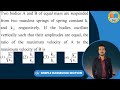
Two bodies A and B of equal mass are suspended from two massless springs of spring constant \( k_1 \) and \( k_2 \), respectively. If the bodies oscillate vertically such that their amplitudes are equal, the ratio of the maximum velocity of A to the maximum velocity of B is:
Two bodies A and B of equal mass are suspended from two massless springs of spring constant \( k_1 \) and \( k_2 \), respectively. If the bodies oscillate vertically such that their amplitudes are equal, the ratio of the maximum velocity of A to the maximum velocity of B is:
Show Hint
In simple harmonic motion, the maximum velocity of an oscillating body is directly proportional to the amplitude and angular frequency. For systems with equal amplitudes, the ratio of maximum velocities depends on the square root of the ratio of spring constants.
Updated On: Apr 19, 2026
- \( \frac{k_1}{k_2} \)
- \( \frac{k_2}{k_1} \)
- \( \sqrt{\frac{k_2}{k_1}} \)
- \( \sqrt{\frac{k_1}{k_2}} \)
Show Solution
The Correct Option is D
Solution and Explanation
The maximum velocity \( v_{\text{max}} \) of a spring-mass system in simple harmonic motion is \( v_{\text{max}} = A \omega \), where \( A \) is the amplitude and \( \omega \) is the angular frequency. The angular frequency \( \omega \) is defined as \( \omega = \sqrt{\frac{k}{m}} \), with \( k \) being the spring constant and \( m \) the mass. For two bodies with identical amplitudes, the ratio of their maximum velocities is \( \frac{v_A}{v_B} = \frac{A \omega_A}{A \omega_B} = \frac{\omega_A}{\omega_B} = \sqrt{\frac{k_1}{k_2}} \). Consequently, the ratio of the maximum velocity of body A to that of body B equals \( \sqrt{\frac{k_1}{k_2}} \).
Was this answer helpful?
0
Learn with videos:
Top Questions on Waves and Oscillations
- What is the fundamental frequency of an open organ pipe with length \( L \) and speed of sound \( v \)?
- MHT CET - 2024
- Physics
- Waves and Oscillations
- If a copper rod carries a direct current, the magnetic field associated with the current will be?
- MHT CET - 2024
- Physics
- Waves and Oscillations
- A pendulum having a negatively charged metal knob is oscillating on a positively charged surface. The time of the pendulum will be:
- MHT CET - 2024
- Physics
- Waves and Oscillations
- A particle is executing Simple Harmonic Motion (SHM). The ratio of potential energy and kinetic energy of the particle when its displacement is half of its amplitude will be:
- MHT CET - 2024
- Physics
- Waves and Oscillations
- Want to practice more? Try solving extra ecology questions todayView All Questions
