Two blocks of masses 10 kg and 30 kg are placed on the same straight line with coordinates(0, 0) cm and (x, 0) cm respectively. The block of 10 kg is moved on the same line through a distance of 6 cm towards the other block. The distance through which the block of 30 kg must be moved to keep the position of Centre of mass of the system unchanged is
- 4 cm towards the 10 kg block
- 2 cm away from the 10 kg block
- 2 cm towards the 10 kg block
- 4 cm away from the 10 kg block
The Correct Option is C
Solution and Explanation
To solve this problem, we need to ensure that the center of mass of the system remains unchanged when the 10 kg block is moved. We will use the concept of the center of mass and its formula.
The center of mass (x_{cm}) of a system of two blocks is given by:
x_{cm} = \frac{m_1 \cdot x_1 + m_2 \cdot x_2}{m_1 + m_2}
where m_1 and m_2 are the masses of the blocks, and x_1 and x_2 are their respective initial positions.
Initially:
- m_1 = 10 \, \text{kg}, x_1 = 0 \, \text{cm}
- m_2 = 30 \, \text{kg}, x_2 = x \, \text{cm}
The initial center of mass is:
x_{cm} = \frac{10 \cdot 0 + 30 \cdot x}{10 + 30} = \frac{30x}{40} = \frac{3x}{4}
Now, the 10 kg block is moved 6 cm towards the 30 kg block, so its new position is 6 cm. Let the 30 kg block be moved d cm towards the 10 kg block to maintain the same center of mass position.
New positions:
- x_1' = 6 \, \text{cm}
- x_2' = x - d \, \text{cm}
The new center of mass should be equal to the initial center of mass:
\frac{10 \cdot 6 + 30 \cdot (x - d)}{40} = \frac{3x}{4}
Solving for d:
60 + 30x - 30d = 30x \quad \Rightarrow \quad 60 = 30d \quad \Rightarrow \quad d = 2 \, \text{cm}
Thus, to keep the center of mass of the system unchanged, the 30 kg block must be moved 2 cm towards the 10 kg block.
The correct answer is: 2 cm towards the 10 kg block
Top Questions on Centre of mass
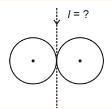
- Two solid spheres each of mass 2 kg and radius 75 cm are arranged as shown. Find MOI of the system about the given axis.
- JEE Main - 2024
- Physics
- Centre of mass
- Three blocks A, B and C are pulled on a horizontal smooth surface by a force of 80 N as shown in figure

The tensions T1 and T2 in the string are respectively:- JEE Main - 2024
- Physics
- Centre of mass
Find the value of m if \(M = 10\) \(kg\). All the surfaces are rough.
- JEE Main - 2024
- Physics
- Centre of mass
A non-uniform bar of weight W is suspended at rest by two strings of negligible weight as shown in Fig.6.33. The angles made by the strings with the vertical are 36.9° and 53.1° respectively. The bar is 2 m long. Calculate the distance d of the centre of gravity of the bar from its left end.

- CBSE Class XI
- Physics
- Centre of mass
- Want to practice more? Try solving extra ecology questions todayView All Questions
