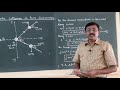
The track shown in the figure is frictionless. The block B of mass 4 kg is lying at rest and block A of mass 2 kg is pushed along the track with some speed. The collision between A and B is perfectly elastic.With what velocity should the block A start such that block B just reaches at point P?
To solve this problem, we need to ensure that block B reaches point P after the perfectly elastic collision with block A. Given that the track is frictionless and the collision is perfectly elastic, we'll make use of the conservation of momentum and the conservation of kinetic energy.
Step 1: Understand the Problem Context
In a perfectly elastic collision between two objects, both the total kinetic energy and total momentum are conserved. We need to determine the initial velocity of block A so that block B, after the collision, just reaches point P.
Step 2: Apply Conservation of Momentum
The initial momentum of the system is all in block A because block B is at rest:
p_{\text{initial}} = m_A \cdot v_A, where v_A is the initial velocity of block A.
After the collision, the momentum will be shared between both blocks:
p_{\text{final}} = m_A \cdot v_{A_f} + m_B \cdot v_{B_f}, where v_{A_f} and v_{B_f} are the final velocities of blocks A and B respectively.