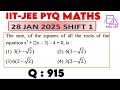
The sum of the squares of all the roots of the equation \( x^2 + [2x - 3] - 4 = 0 \) is:
Show Hint
- \(3(2 - \sqrt{2})\)
- \(6(2 - \sqrt{2})\)
- \(3(3 - \sqrt{2})\)
\(6(2 - \sqrt{2})\)
The Correct Option is D
Solution and Explanation
The given equation is: \[ x^2 + |2x - 3| - 4 = 0 \]
Case 1: \( x \geq \frac{3}{2} \)
With this condition, \( |2x - 3| = 2x - 3 \). The equation becomes: \[ x^2 + (2x - 3) - 4 = 0 \] This simplifies to: \[ x^2 + 2x - 7 = 0 \] The solution for this quadratic equation is: \[ x = \frac{-2 \pm \sqrt{2^2 - 4(1)(-7)}}{2(1)} = \frac{-2 \pm \sqrt{4 + 28}}{2} = \frac{-2 \pm \sqrt{32}}{2} = \frac{-2 \pm 4\sqrt{2}}{2} = -1 \pm 2\sqrt{2} \] Since we are in the case \( x \geq \frac{3}{2} \), we select \( x = -1 + 2\sqrt{2} \), which is approximately \( -1 + 2.828 = 1.828 \). The other solution, \( -1 - 2\sqrt{2} \), is negative and thus not in this case.
Case 2: \( x < \frac{3}{2} \)
With this condition, \( |2x - 3| = -(2x - 3) = 3 - 2x \). The equation becomes: \[ x^2 + (3 - 2x) - 4 = 0 \] This simplifies to: \[ x^2 - 2x - 1 = 0 \] The solution for this quadratic equation is: \[ x = \frac{-(-2) \pm \sqrt{(-2)^2 - 4(1)(-1)}}{2(1)} = \frac{2 \pm \sqrt{4 + 4}}{2} = \frac{2 \pm \sqrt{8}}{2} = \frac{2 \pm 2\sqrt{2}}{2} = 1 \pm \sqrt{2} \] Since we are in the case \( x<\frac{3}{2} \), we select \( x = 1 - \sqrt{2} \), which is approximately \( 1 - 1.414 = -0.414 \). The other solution, \( 1 + \sqrt{2} \), is approximately \( 1 + 1.414 = 2.414 \) and thus not in this case.
Sum of Squares Calculation:
The solutions found are \( x_1 = 2\sqrt{2} - 1 \) and \( x_2 = 1 - \sqrt{2} \). We need to calculate the sum of their squares:
\[ (2\sqrt{2} - 1)^2 + (1 - \sqrt{2})^2 \] Expansion of the first term: \( (2\sqrt{2})^2 - 2(2\sqrt{2})(1) + 1^2 = 8 - 4\sqrt{2} + 1 = 9 - 4\sqrt{2} \).
Expansion of the second term: \( 1^2 - 2(1)(\sqrt{2}) + (\sqrt{2})^2 = 1 - 2\sqrt{2} + 2 = 3 - 2\sqrt{2} \).
Summing these expansions:
\[ (9 - 4\sqrt{2}) + (3 - 2\sqrt{2}) \] Simplification:
\[ = 9 + 3 - 4\sqrt{2} - 2\sqrt{2} = 12 - 6\sqrt{2} \] This can be factored as: \[ 6(2 - \sqrt{2}) \]
Final Answer:
The sum of the squares of the solutions is \(6(2 - \sqrt{2})\).
Learn with videos:
Top Questions on Quadratic Equations
- The equation \( (\cos p - 1)x^2 + (\cos p)x + \sin p = 0 \), where \( x \) is a variable with real roots. Then the interval of \( p \) may be any one of the following:
- MHT CET - 2024
- Mathematics
- Quadratic Equations
- If the roots of the quadratic equation \( x^2 - 7x + 12 = 0 \) are \( \alpha \) and \( \beta \), then the value of \( \alpha + \beta \) is:
- MHT CET - 2025
- Mathematics
- Quadratic Equations
- Find the roots of the quadratic equation $ x^2 - 5x + 6 = 0 $.
- MHT CET - 2025
- Mathematics
- Quadratic Equations
- Find the sum of the roots of the quadratic equation $ 2x^2 - 5x + 3 = 0 $.
- MHT CET - 2025
- Mathematics
- Quadratic Equations
- Want to practice more? Try solving extra ecology questions todayView All Questions
