The sides AB and CD of a trapezium ABCD are parallel, with AB being the smaller side. P is the midpoint of CD and ABPD is a parallelogram. If the difference between the areas of the parallelogram ABPD and the triangle BPC is 10 sq cm, then the area, in sq cm, of the trapezium ABCD is
- 20
- 25
- 40
- 30
The Correct Option is D
Solution and Explanation
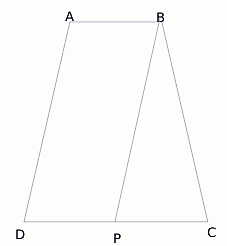
Let the length of DP be \( x \). Since \( DP = AB \), it follows that:
\[ AB = x \]
Given that \( DP = CP \), the total length \( CD \) is:
\[ CD = DP + CP = x + x = 2x \]
Let the height of the trapezium be \( h \).
Step 1: Area of Parallelogram ABPD
The area of a parallelogram is calculated as base × height:
\[ \text{Area}_{ABPD} = AB \times h = xh \]
Step 2: Area of Triangle BPC
Triangle BPC is a right triangle with base \( x \) and height \( h \). Its area is:
\[ \text{Area}_{\triangle BPC} = \frac{1}{2} \times x \times h = \frac{1}{2}xh \]
Step 3: Given Condition
The problem states that the area of the parallelogram minus the area of the triangle equals 10:
\[ xh - \frac{1}{2}xh = 10 \Rightarrow \frac{1}{2}xh = 10 \Rightarrow xh = 20 \]
Step 4: Area of Trapezium ABCD
The trapezium has parallel sides \( AB = x \) and \( CD = 2x \), with a height \( h \). The area is calculated as:
\[ \text{Area}_{ABCD} = \frac{1}{2}(AB + CD) \times h = \frac{1}{2}(x + 2x)h = \frac{1}{2}(3x)h = \frac{3}{2}xh \]
Using the previously determined value \( xh = 20 \):
\[ \text{Area}_{ABCD} = \frac{3}{2} \times 20 = 30 \]
Final Answer:
Option (D): \( \boxed{30} \)
Top Questions on Geometry
- A rectangle \(ABCD\) has sides \(AB = 45 \, \text{cm}\) and \(BC = 26 \, \text{cm}\). Point \(E\) is the midpoint of side \(CD\). Find the radius of the incircle of the triangle \(\triangle AED\).
- CAT - 2024
- Quantitative Aptitude
- Geometry
- The coordinates of the foot of perpendicular from the point \( (2, 3) \) on the line \( y = 3x + 4 \) is given by:
- VITEEE - 2024
- Mathematics
- Geometry
- The points A(4, -2, 1), B(7, -4, 7), C(2, -5, 10), and D(-1, -3, 4) are the vertices of a:
- VITEEE - 2024
- Mathematics
- Geometry
- If A, B, C, D are the angles of a quadrilateral, then \[ \frac{\tan A + \tan B + \tan C + \tan D}{\cot A + \cot B + \cot C + \cot D} = \]
- VITEEE - 2024
- Mathematics
- Geometry
- Want to practice more? Try solving extra ecology questions todayView All Questions