Question:medium
The refractive index of the material of a prism is √2 and the angle of the prism is 30°. One of the two refracting surfaces of the prism is made a mirror inwards, by silver coating. A beam of monochromatic light entering the prism from the other face will retrace its path (after reflection from the silvered surface) if its angle of incidence on the prism is
The refractive index of the material of a prism is √2 and the angle of the prism is 30°. One of the two refracting surfaces of the prism is made a mirror inwards, by silver coating. A beam of monochromatic light entering the prism from the other face will retrace its path (after reflection from the silvered surface) if its angle of incidence on the prism is
Updated On: Apr 23, 2026
- 60°
- 30°
- 45°
- Zero
Show Solution
The Correct Option is C
Solution and Explanation
To solve this problem, we need to understand the behavior of the light in the context of the prism with a silvered surface. Here are the step-by-step details:
- First, recognize that the refractive index of the prism material is given as \sqrt{2}, and the prism angle is 30^\circ.
- When a beam of light enters the prism, it refracts at the first surface. It then internally reflects off the silvered surface, which acts like a mirror.
- The light beam would retrace its path if, after reflection, it strikes the original surface at the same angle it was incident.
- Using the principle of reversibility of light, we know for the light to retrace its path, the angle of reflection at the silvered surface should be such that the angle of incidence at the first surface equals the angle of refraction back into the prism.
- The condition for retracing the path leads us to the angle of incidence at the first prism face being equal to the angle of refraction upon re-entering into the same medium.
To find the angle at which the light should enter the prism, consider the geometry and laws of refraction:
- Since only one surface of the prism is silvered, the prism effectively behaves like a right-angle prism for an observing eye.
- The refraction law is given by n \sin i = \sin r,
where n is the refractive index, i is the angle of incidence, and r is the angle of refraction.
For this problem:
- When the angle of prism is 30^\circ and the refractive index \sqrt{2}, we need the angle i such that the internal angle at the silvered surface leads to the light retracing the path.
- For the given setup, the angle of incidence i is calculated to be 45^\circ using Snell's law and the geometric principles of light reflecting back along its own path due to the mirror surface.
Therefore, the correct answer is 45^\circ, making the angle of incidence required to retrace its path upon reflection 45^\circ.
Was this answer helpful?
2
Top Questions on Refraction Through A Prism
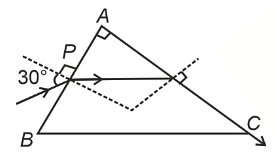
- A light ray enters through a right angled prism at point P with the angle of incidence 30° as shown in figure. It travels through the prism parallel to its base BC and emerges along the face AC. The refractive index of the prism is :
- NEET (UG) - 2024
- Physics
- Refraction Through A Prism
- A laser beam of wavelength 500 nm and power 5 mW strikes normally on a perfectly reflecting surface of area 1 mm\(^2\) of a body. It rebounds back from the surface. Find the force exerted by the laser beam on the body.
- CBSE Class XII - 2025
- Physics
- Refraction Through A Prism
- A ray of light is incident on face AB of a prism ABC with angle of prism \( A \) and emerges out from face AC. The prism is set in the position of minimum deviation with angle of deviation \( \delta \). Find: \begin{enumerate} \item the angle of incidence and \item the angle of refraction on face AB. \end{enumerate}
- CBSE Class XII - 2025
- Physics
- Refraction Through A Prism
- Find the angle of deviation produced by the prism.
- CBSE Class XII - 2025
- Physics
- Refraction Through A Prism
- Want to practice more? Try solving extra ecology questions todayView All Questions

