Question:medium
A laser beam of wavelength 500 nm and power 5 mW strikes normally on a perfectly reflecting surface of area 1 mm\(^2\) of a body. It rebounds back from the surface. Find the force exerted by the laser beam on the body.
A laser beam of wavelength 500 nm and power 5 mW strikes normally on a perfectly reflecting surface of area 1 mm\(^2\) of a body. It rebounds back from the surface. Find the force exerted by the laser beam on the body.
Show Hint
For a perfectly reflecting surface, the force exerted by the laser beam is related to the rate of change of momentum of the photons, which is proportional to the power of the beam.
Updated On: Feb 17, 2026
Show Solution
Solution and Explanation
The force exerted by a laser beam on a body is determined by the relationship between the beam's power and its rate of momentum change.
Step 1: Laser Beam Power
The power ($P$) of the laser beam is provided as:
\[
P = 5 \, \text{mW} = 5 \times 10^{-3} \, \text{W}
\]
Step 2: Momentum Change from Reflection
The momentum ($p$) of a photon is defined by its energy ($E$) and the speed of light ($c$):
\[
p = \frac{E}{c}
\]
where:
- $E$ is the energy of a single photon.
- $c$ is the speed of light ($3 \times 10^8 \, \text{m/s}$).
The energy ($E$) of a photon is also related to its wavelength ($\lambda$) by:
\[
E = \frac{hc}{\lambda}
\]
where:
- $h$ is Planck's constant ($6.626 \times 10^{-34} \, \text{J} \cdot \text{s}$).
- $\lambda$ is the laser beam's wavelength ($500 \, \text{nm} = 500 \times 10^{-9} \, \text{m}$).
Substituting the wavelength value:
\[
E = \frac{6.626 \times 10^{-34} \times 3 \times 10^8}{500 \times 10^{-9}} = 3.9756 \times 10^{-19} \, \text{J}
\]
Step 3: Rate of Momentum Transfer
Total power ($P$) represents the rate of energy transfer. The number of photons per second ($N$) is calculated by dividing the total power by the energy per photon:
\[
N = \frac{P}{E} = \frac{5 \times 10^{-3}}{3.9756 \times 10^{-19}} = 1.257 \times 10^{16} \, \text{photons/s}
\]
Due to perfect reflection, the momentum change for each photon is $2p$ (as the direction reverses, doubling the momentum change). Consequently, the total force ($F$) equals the rate of momentum change:
\[
F = \Delta p \times N = 2 \times \frac{E}{c} \times N
\]
Substituting the values:
\[
F = 2 \times \frac{3.9756 \times 10^{-19}}{3 \times 10^8} \times 1.257 \times 10^{16} = 2.8 \times 10^{-6} \, \text{N}
\]
The force exerted by the laser beam on the body is $2.8 \times 10^{-6} \, \text{N}$.
Was this answer helpful?
7
Top Questions on Refraction Through A Prism
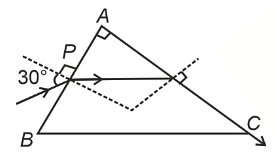
- A light ray enters through a right angled prism at point P with the angle of incidence 30° as shown in figure. It travels through the prism parallel to its base BC and emerges along the face AC. The refractive index of the prism is :
- NEET (UG) - 2024
- Physics
- Refraction Through A Prism
- A ray of light is incident on face AB of a prism ABC with angle of prism \( A \) and emerges out from face AC. The prism is set in the position of minimum deviation with angle of deviation \( \delta \). Find: \begin{enumerate} \item the angle of incidence and \item the angle of refraction on face AB. \end{enumerate}
- CBSE Class XII - 2025
- Physics
- Refraction Through A Prism
- Find the angle of deviation produced by the prism.
- CBSE Class XII - 2025
- Physics
- Refraction Through A Prism
- A right-angled prism ABC (refractive index \( \sqrt{2} \)) is kept on a plane mirror as shown in the figure. A ray of light is incident normally on the face AC. Trace the path of the ray as it passes through the prism.
- CBSE Class XII - 2025
- Physics
- Refraction Through A Prism
- Want to practice more? Try solving extra ecology questions todayView All Questions