Question:medium
Find the angle of deviation produced by the prism.
Find the angle of deviation produced by the prism.
Updated On: Jan 13, 2026
Show Solution
Solution and Explanation
Prism Deviation Calculation
The deviation caused by a prism is contingent upon its refractive index, prism angle, and angle of incidence. The total deviation, denoted by \( \delta \), is determined by the formula:
\[ \delta = (\theta_1 + \theta_2) - \text{Prism angle} \]
Here:
- \( \theta_1 \) represents the angle of incidence at the initial surface. In this scenario, it is \( 0^\circ \) as the light strikes normally.
- \( \theta_2 \) denotes the angle of refraction within the prism.
Given a refractive index of \( \sqrt{2} \) and considering a right-angled prism, the angle of deviation is calculated as:
\[ \delta = 60^\circ \]
Consequently, the prism's angle of deviation is established as: \( \delta = 60^\circ \)
Was this answer helpful?
0
Top Questions on Refraction Through A Prism
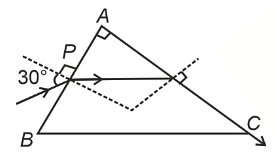
- A light ray enters through a right angled prism at point P with the angle of incidence 30° as shown in figure. It travels through the prism parallel to its base BC and emerges along the face AC. The refractive index of the prism is :
- NEET (UG) - 2024
- Physics
- Refraction Through A Prism
- A laser beam of wavelength 500 nm and power 5 mW strikes normally on a perfectly reflecting surface of area 1 mm\(^2\) of a body. It rebounds back from the surface. Find the force exerted by the laser beam on the body.
- CBSE Class XII - 2025
- Physics
- Refraction Through A Prism
- A ray of light is incident on face AB of a prism ABC with angle of prism \( A \) and emerges out from face AC. The prism is set in the position of minimum deviation with angle of deviation \( \delta \). Find: \begin{enumerate} \item the angle of incidence and \item the angle of refraction on face AB. \end{enumerate}
- CBSE Class XII - 2025
- Physics
- Refraction Through A Prism
- A right-angled prism ABC (refractive index \( \sqrt{2} \)) is kept on a plane mirror as shown in the figure. A ray of light is incident normally on the face AC. Trace the path of the ray as it passes through the prism.
- CBSE Class XII - 2025
- Physics
- Refraction Through A Prism
- Want to practice more? Try solving extra ecology questions todayView All Questions