The part of the brain responsible for maintaining posture and balance is the:
Show Hint
- Cerebrum
- Medulla oblongata
- Cerebellum
- Hypothalamus
The Correct Option is C
Solution and Explanation
To address the problem, we will examine the brain's components and identify the one responsible for posture and balance.
1. Brain Overview
The brain functions as the body's central command. It governs thought, movement, sensation, and survival. The brain comprises various sections, each fulfilling a distinct role.
2. Key Brain Regions:
- Cerebrum: The brain's largest section, it governs cognition, learning, memory, emotions, and voluntary actions such as walking and speaking.
- Cerebellum: Situated at the posterior and inferior part of the brain, beneath the cerebrum. Though smaller, it is crucial for motor coordination.
- Medulla Oblongata: Regulates involuntary functions like heart rate, respiration, and digestion.
3. Cerebellum's Function:
- The cerebellum manages balance and posture.
- It ensures fluid and accurate bodily movements.
- For instance, when walking, running, or balancing on one foot, the cerebellum provides stability.
- It processes sensory input from the eyes, ears, muscles, and joints regarding the body's position and motion.
- Subsequently, it sends signals to muscles to make adjustments for maintaining equilibrium.
4. Significance:
- Without the cerebellum, an individual may experience instability or difficulty walking upright.
- It aids in fall prevention through continuous muscular adjustments.
Final Answer:
The brain region responsible for maintaining posture and balance is the cerebellum.
Top Questions on Human body
- Which of the following is not a part of the human digestive system?
- CUET (UG) - 2025
- Biology
- Human body
- Which part of the nephron is primarily responsible for filtration of blood?
- CUET (UG) - 2025
- Biology
- Human body
- The large bean-shaped organ acting as a filter of the blood in humans is:
- CBSE Class XII - 2025
- Biology
- Human body
- Three types of muscles are given as a, b and c. Identify the correct matching pair along with their location in human body :
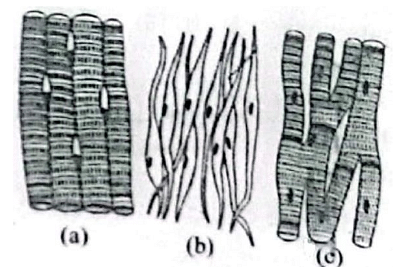
- NEET (UG) - 2024
- Biology
- Human body
- Want to practice more? Try solving extra ecology questions todayView All Questions