Question:medium
The liquid (mercury) meniscus in capillary tube will be convex if the angle of contact is
The liquid (mercury) meniscus in capillary tube will be convex if the angle of contact is
Show Hint
Convex meniscus = obtuse angle = non-wetting liquid; Concave meniscus = acute angle = wetting liquid.
Updated On: May 14, 2026
- greater than \(90^{\circ}\)
- less than \(90^{\circ}\)
- equal to \(90^{\circ}\)
- equal to \(0^{\circ}\)
Show Solution
The Correct Option is A
Solution and Explanation
Step 1: Understanding the Question:
The shape of the liquid surface (meniscus) in a capillary tube depends on the adhesive and cohesive forces, which are characterized by the angle of contact.
Step 3: Detailed Explanation:
The angle of contact \(\theta\) is the angle between the tangent to the liquid surface at the point of contact and the solid surface inside the liquid.
1) If \(\theta<90^{\circ}\) (acute), the meniscus is concave (e.g., water in glass). This happens when adhesive forces are stronger than cohesive forces.
2) If \(\theta>90^{\circ}\) (obtuse), the meniscus is convex (e.g., mercury in glass). This happens when cohesive forces are stronger than adhesive forces.
3) If \(\theta = 90^{\circ}\), the meniscus is flat.
Since the question specifies a convex meniscus (mercury), the angle of contact must be obtuse.
Step 4: Final Answer:
The angle of contact is greater than \(90^{\circ}\).
The shape of the liquid surface (meniscus) in a capillary tube depends on the adhesive and cohesive forces, which are characterized by the angle of contact.
Step 3: Detailed Explanation:
The angle of contact \(\theta\) is the angle between the tangent to the liquid surface at the point of contact and the solid surface inside the liquid.
1) If \(\theta<90^{\circ}\) (acute), the meniscus is concave (e.g., water in glass). This happens when adhesive forces are stronger than cohesive forces.
2) If \(\theta>90^{\circ}\) (obtuse), the meniscus is convex (e.g., mercury in glass). This happens when cohesive forces are stronger than adhesive forces.
3) If \(\theta = 90^{\circ}\), the meniscus is flat.
Since the question specifies a convex meniscus (mercury), the angle of contact must be obtuse.
Step 4: Final Answer:
The angle of contact is greater than \(90^{\circ}\).
Was this answer helpful?
0
Top Questions on Viscosity
- An air bubble of diameter 6 mm rises steadily through a solution of density 1750kg / m3 at the rate of 0.35 cm/s. The co-efficient of viscosity of the solution (neglect density of air) is ____Pas (given, g = 10ms-2)
- JEE Main - 2023
- Physics
- Viscosity
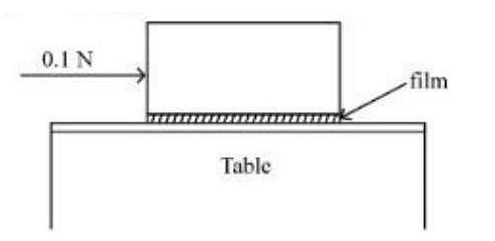
- A metal block of base area \(0.20 \,m^2\) is placed on a table, as shown in figure. A liquid film of thickness \(0.25\, mm\) is inserted between the block and the table. The block is pushed by a horizontal force of 0.1 N and moves with a constant speed. If the viscosity of the liquid is \(5.0×10^{−3}Pl\), the speed of block is ________ \(×10^{−3}m/s\)
- JEE Main - 2023
- Physics
- Viscosity
- The diameter of an air bubble which was initially 2 mm, rises steadily through a solution of density 1750 kg m–3 at the rate of 0.35 cms–1. The coefficient of viscosity of the solution is _______ poise (in nearest integer). (The density of air is negligible).
- JEE Main - 2022
- Physics
- Viscosity
A spherical ball is dropped in a long column of viscous liquid. The speed v of the ball as a function of time t may be best represented by

- BITSAT - 2010
- Physics
- Viscosity
- Want to practice more? Try solving extra ecology questions todayView All Questions