The half-life of a radioactive substance is 30 min. The time for disintegration \(\frac{7}{8}\)th part of its original mass will be:
- T
- 2T
- 3T
- 8T
The Correct Option is C
Solution and Explanation
To solve the problem of determining the time required for the disintegration of \(\frac{7}{8}\)th part of a radioactive substance, we will use the concept of radioactive decay and half-life.
The half-life of a radioactive substance is the time required for its quantity to reduce to half of its initial value. Given:
- The half-life (\(T_{1/2}\)) of the substance is 30 minutes.
We need to find the time taken for the substance to decay to \(\frac{1}{8}\) of its original mass, as disintegration of \(\frac{7}{8}\) implies only \(\frac{1}{8}\) is left.
We can use the formula related to radioactive decay:
where:
- \(N(t)\) is the remaining quantity of the substance at time \(t\).
- \(N_0\) is the initial quantity.
- \(T_{1/2}\) is the half-life of the substance.
We need to solve for \(t\) when \(N(t) = \frac{1}{8} N_0\).
Dividing both sides by \(N_0\), we get:
We recognize \(\frac{1}{8}\) is \(\left(\frac{1}{2}\right)^3\), so:
Equating the exponents, we obtain:
Solving for \(t\), we get:
Substituting \(T_{1/2} = 30 \text{ min}\):
Therefore, the time required for the disintegration of \(\frac{7}{8}\)th part of the original mass is 90 minutes or 3T, where \(T = 30 \text{ min}\).
Top Questions on Centre of mass
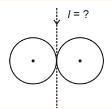
- Two solid spheres each of mass 2 kg and radius 75 cm are arranged as shown. Find MOI of the system about the given axis.
- JEE Main - 2024
- Physics
- Centre of mass
- Three blocks A, B and C are pulled on a horizontal smooth surface by a force of 80 N as shown in figure

The tensions T1 and T2 in the string are respectively:- JEE Main - 2024
- Physics
- Centre of mass
Find the value of m if \(M = 10\) \(kg\). All the surfaces are rough.
- JEE Main - 2024
- Physics
- Centre of mass
A non-uniform bar of weight W is suspended at rest by two strings of negligible weight as shown in Fig.6.33. The angles made by the strings with the vertical are 36.9° and 53.1° respectively. The bar is 2 m long. Calculate the distance d of the centre of gravity of the bar from its left end.

- CBSE Class XI
- Physics
- Centre of mass
- Want to practice more? Try solving extra ecology questions todayView All Questions
