Question:medium
The formula for magnetic field of a certain component is given by
\[
B = \frac{\mu_0 Ni}{2\pi r}
\]
where, \(N\) = total number of turns, \(i\) = current, \(r\) = radius. The component is:
The formula for magnetic field of a certain component is given by
\[
B = \frac{\mu_0 Ni}{2\pi r}
\]
where, \(N\) = total number of turns, \(i\) = current, \(r\) = radius. The component is:
Show Hint
Toroid field depends on \( \frac{1}{r} \), unlike solenoid (constant field).
Updated On: Jun 16, 2026
- ring
- solenoid
- toroid
- None of these
Show Solution
The Correct Option is C
Solution and Explanation
The given formula for the magnetic field is:
\(B = \frac{\mu_0 Ni}{2\pi r}\),
where:
- \(\mu_0\) is the permeability of free space.
- \(N\) is the total number of turns.
- \(i\) is the current flowing through the coil.
- \(r\) is the radius.
The component described by this formula is a toroid. Let's understand why this is the correct answer:
- **Toroid Characteristics:** A toroid is a doughnut-shaped coil used to create a magnetic field. The magnetic field inside a toroid is essentially circular and remains confined within the core, which is why the formula contains \(2\pi r\) in the denominator. This accounts for the circumference along which the magnetic field is spread.
- **Formula Comparison:** In the formula \(B = \frac{\mu_0 Ni}{2\pi r}\), the presence of \(2\pi r\) indicates a circular or cylindrical path, typical in toroidal structures.
- **Exclusion of Other Options:**
- Ring: Typically, a ring without a coil does not produce any magnetic field due to current. The formula for magnetic fields involves coil characteristics with current.
- Solenoid: The magnetic field inside a solenoid is given by \(B = \mu_0 \frac{Ni}{L}\), where \(L\) is the length of the solenoid. This formula is different from the one provided.
- None of these: Not applicable as the provided formula specifically describes a toroid.
Therefore, the correct answer is a toroid.
Was this answer helpful?
0
Top Questions on Amperes circuital law
- A coil has a resistance of \( 30 \, \Omega \) and an inductive reactance of \( 20 \, \Omega \) at 50 Hz frequency. If an AC source of 200 V and 100 Hz is connected across the coil, then how much current will flow through the coil?
- MHT CET - 2024
- Physics
- Amperes circuital law
- In a series LCR circuit connected to an AC source, at resonance, the current is maximum because:
- MHT CET - 2024
- Physics
- Amperes circuital law
Consider the circuit shown :
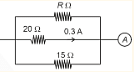 The ammeter reads 0.9 A. Value of R is
- JEE Main - 2024
- Physics
- Amperes circuital law
- A transistor is used in an amplifier circuit in common emitter mode. If the base current changes by 100μA, it brings a change of 10mA in collector current. If the load resistance is 2kΩ and input resistance is 1kΩ, the value of power gain is \(x×10^4\). The value of x is _______.
- JEE Main - 2022
- Physics
- Amperes circuital law
- Want to practice more? Try solving extra ecology questions todayView All Questions