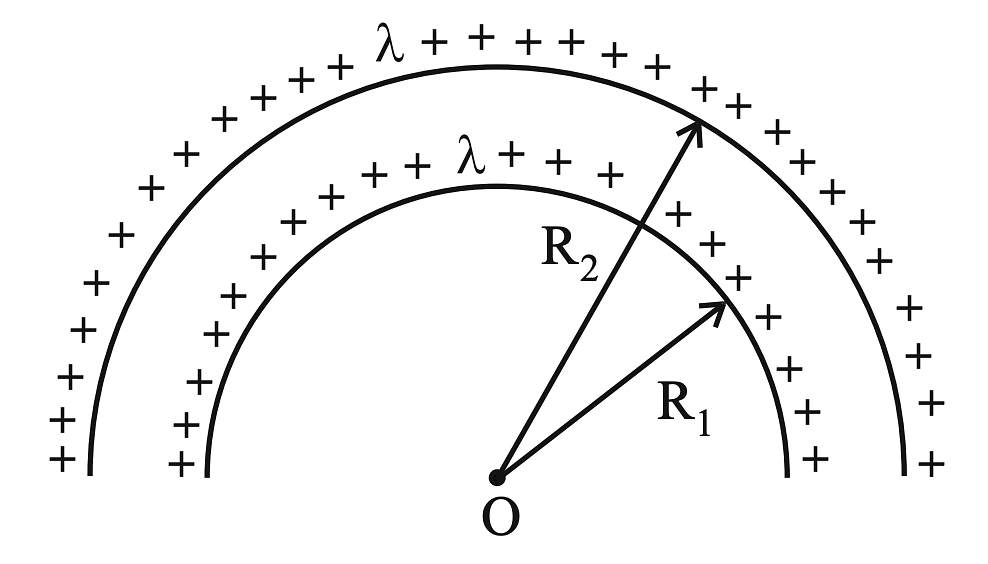
The electric potential at the center of two concentric half rings of radii $R_1$ and $R_2$, having same linear charge density $\lambda$ is :
- $\frac{2 \lambda}{\epsilon_0}$
- $\frac{\lambda}{2 \epsilon_0}$
- $\frac{\lambda}{4 \epsilon_0}$
- $\frac{\lambda}{\epsilon_0}$
The Correct Option is B
Solution and Explanation
To find the electric potential at the center of two concentric half rings with radii \( R_1 \) and \( R_2 \) and the same linear charge density \( \lambda \), we need to consider the contribution from each half ring separately.
The electric potential due to a half ring of radius \( R \) with linear charge density \( \lambda \) can be calculated using the formula:
\(V = \frac{\lambda R}{2\epsilon_0}\)
This formula is derived by considering the symmetrical distribution of charge on the half ring, where each point on the half ring is at a constant distance from the center, and hence contributes uniformly to the potential at the center.
Now, solving for the two half rings:
- Potential due to the inner half ring of radius \( R_1 \):
- \(V_1 = \frac{\lambda R_1}{2 \epsilon_0}\)
- Potential due to the outer half ring of radius \( R_2 \):
- \(V_2 = \frac{\lambda R_2}{2 \epsilon_0}\)
Since potentials are scalar quantities, the total potential at the center is the sum of the potentials due to each half ring:
- Total Potential, \(V = V_1 + V_2 = \frac{\lambda R_1}{2 \epsilon_0} + \frac{\lambda R_2}{2 \epsilon_0}\)
- \(V = \frac{\lambda (R_1 + R_2)}{2 \epsilon_0}\)
Given in the problem, the potential does not depend on \( R_1 \) or \( R_2 \) individually but rather provides a general form when these are specific values.
Therefore, the answer, considering uniform potential due to equal distribution and alignment, simplifies as:
The correct answer is \(\frac{\lambda}{2 \epsilon_0}\).
Top Questions on Gauss Law
- There are two cubical Gaussian surface carrying charges as shown. Find ratio of fluxes through surface \(C_1\) and \(C_2\):

- JEE Main - 2024
- Physics
- Gauss Law
- An electric field \( \vec{E} = (2x \hat{i}) \, \text{N C}^{-1} \) exists in space. A cube of side \( 2 \, \text{m} \) is placed in the space as per the figure given below. The electric flux through the cube is __________ \( \text{N m}^2/\text{C} \).
- JEE Main - 2024
- Physics
- Gauss Law
- A charge q is placed at the center of one of the surface of a cube. The flux linked with the cube is :-
- JEE Main - 2024
- Physics
- Gauss Law
- If the net flux through a cube is 1.05 N m\(^2\) C\(^{-1}\), what will be the total charge inside the cube? (Given: The permittivity of free space is \(8.85 \times 10^{-12}\) C\(^2\) N\(^{-1}\) m\(^{-2}\)).
- CUET (UG) - 2025
- Physics
- Gauss Law
- Want to practice more? Try solving extra ecology questions todayView All Questions
