Question:medium
The area of the region satisfying the inequalities \(|x|-y≤1,y≥0\) and \(y≤1\) is [This Question was asked as TITA]
The area of the region satisfying the inequalities \(|x|-y≤1,y≥0\) and \(y≤1\) is [This Question was asked as TITA]
Updated On: Jan 15, 2026
- 3 Square units
- 2 Square units
- 5 Square units
- 4 Square units
Show Solution
The Correct Option is A
Solution and Explanation
The graph representing the inequalities \(|x|-y≤1,y≥0\) and \(y≤1\) is displayed below: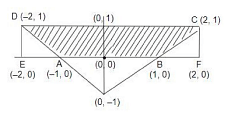
To determine the area of quadrilateral ABCD, the areas of triangles EAD and BFC are subtracted from the area of rectangle EFCD:
Area of ABCD = Area of EFCD − Area of △EAD − Area of △BFC
The formula used is:
\( \text{Area of ABCD} = EF \times FC - \frac{1}{2} \times EA \times ED - \frac{1}{2} \times BF \times FC \)
Substituting the given values yields:
\( = 4 \times 1 - \frac{1}{2} \times 1 \times 1 - \frac{1}{2} \times 1 \times 1 \)
\( = 4 - 0.5 - 0.5 = 3 \) square units
Final Answer: \( \boxed{3} \) square units
Was this answer helpful?
0
Top Questions on Geometry
- A rectangle \(ABCD\) has sides \(AB = 45 \, \text{cm}\) and \(BC = 26 \, \text{cm}\). Point \(E\) is the midpoint of side \(CD\). Find the radius of the incircle of the triangle \(\triangle AED\).
- CAT - 2024
- Quantitative Aptitude
- Geometry
- The coordinates of the foot of perpendicular from the point \( (2, 3) \) on the line \( y = 3x + 4 \) is given by:
- VITEEE - 2024
- Mathematics
- Geometry
- The points A(4, -2, 1), B(7, -4, 7), C(2, -5, 10), and D(-1, -3, 4) are the vertices of a:
- VITEEE - 2024
- Mathematics
- Geometry
- If A, B, C, D are the angles of a quadrilateral, then \[ \frac{\tan A + \tan B + \tan C + \tan D}{\cot A + \cot B + \cot C + \cot D} = \]
- VITEEE - 2024
- Mathematics
- Geometry
- Want to practice more? Try solving extra ecology questions todayView All Questions