Question:easy
Terminal velocity of a small sphere falling in viscous liquid varies with radius as:
Terminal velocity of a small sphere falling in viscous liquid varies with radius as:
Show Hint
Terminal velocity increases with square of radius because gravitational force grows as r^3 while drag grows as r.
Updated On: Jun 10, 2026
- v_t r
- v_t r^2
- v_t 1r
- v_t 1r^2
Show Solution
The Correct Option is B
Solution and Explanation
Step 1: Understand terminal velocity.
When a small sphere falls through a thick liquid, it speeds up at first, then reaches a steady speed. This steady speed is called the terminal velocity. We want to see how it depends on the radius.
Step 2: Balance the forces.
At terminal velocity the downward weight is balanced by the upward buoyancy and the viscous drag. So the net force is zero and the sphere falls steadily.
Step 3: Use Stokes' law.
Solving the force balance using Stokes' law for drag gives the terminal velocity: \[ v_t = \frac{2 r^2 (\rho - \sigma) g}{9 \eta} \] Here $r$ is the radius, $\rho$ is the density of the sphere, $\sigma$ is the density of the liquid and $\eta$ is the viscosity.
Step 4: Spot the radius dependence.
Look at the formula. Everything except $r$ is a constant for a given sphere and liquid. The only place radius appears is as $r^2$.
Step 5: Write the proportionality.
Since the rest is constant, the terminal velocity is proportional to the square of the radius: \[ v_t \propto r^2 \]
Step 6: Choose the correct option.
A bigger sphere falls faster, and the dependence is on the square of the radius. So the correct relation is $v_t \propto r^2$. \[ \boxed{v_t \propto r^2} \]
When a small sphere falls through a thick liquid, it speeds up at first, then reaches a steady speed. This steady speed is called the terminal velocity. We want to see how it depends on the radius.
Step 2: Balance the forces.
At terminal velocity the downward weight is balanced by the upward buoyancy and the viscous drag. So the net force is zero and the sphere falls steadily.
Step 3: Use Stokes' law.
Solving the force balance using Stokes' law for drag gives the terminal velocity: \[ v_t = \frac{2 r^2 (\rho - \sigma) g}{9 \eta} \] Here $r$ is the radius, $\rho$ is the density of the sphere, $\sigma$ is the density of the liquid and $\eta$ is the viscosity.
Step 4: Spot the radius dependence.
Look at the formula. Everything except $r$ is a constant for a given sphere and liquid. The only place radius appears is as $r^2$.
Step 5: Write the proportionality.
Since the rest is constant, the terminal velocity is proportional to the square of the radius: \[ v_t \propto r^2 \]
Step 6: Choose the correct option.
A bigger sphere falls faster, and the dependence is on the square of the radius. So the correct relation is $v_t \propto r^2$. \[ \boxed{v_t \propto r^2} \]
Was this answer helpful?
0
Top Questions on Viscosity
- An air bubble of diameter 6 mm rises steadily through a solution of density 1750kg / m3 at the rate of 0.35 cm/s. The co-efficient of viscosity of the solution (neglect density of air) is ____Pas (given, g = 10ms-2)
- JEE Main - 2023
- Physics
- Viscosity
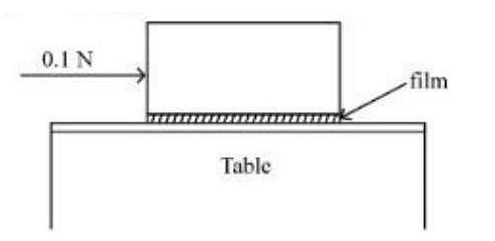
- A metal block of base area \(0.20 \,m^2\) is placed on a table, as shown in figure. A liquid film of thickness \(0.25\, mm\) is inserted between the block and the table. The block is pushed by a horizontal force of 0.1 N and moves with a constant speed. If the viscosity of the liquid is \(5.0×10^{−3}Pl\), the speed of block is ________ \(×10^{−3}m/s\)
- JEE Main - 2023
- Physics
- Viscosity
- The diameter of an air bubble which was initially 2 mm, rises steadily through a solution of density 1750 kg m–3 at the rate of 0.35 cms–1. The coefficient of viscosity of the solution is _______ poise (in nearest integer). (The density of air is negligible).
- JEE Main - 2022
- Physics
- Viscosity
A spherical ball is dropped in a long column of viscous liquid. The speed v of the ball as a function of time t may be best represented by

- BITSAT - 2010
- Physics
- Viscosity
- Want to practice more? Try solving extra ecology questions todayView All Questions