Suppose the length of each side of a regular hexagon ABCDEF is 2 cm. It T is the mid point of CD, then the length of AT, in cm, is
\(\sqrt{15}\)
\(\sqrt{13}\)
\(\sqrt{12}\)
\(\sqrt{14}\)
The Correct Option is B
Solution and Explanation
A regular hexagon can be conceptually divided into 6 equilateral triangles. A line connecting two opposite vertices of the hexagon is formed by the sides of two opposing equilateral triangles. Thus, its length is double the side length of the hexagon, which is 4 cm.
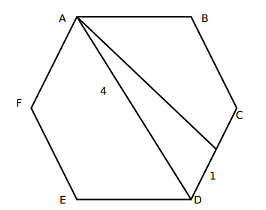
Line \( AD \) divides the hexagon into two equal halves and bisects angle \( D \), resulting in angle \( ADC \) being 60°.
The cosine formula is used to calculate \( AT \):
\[ AT^2 = 4^2 + 1^2 - 2 \times 1 \times 4 \times \cos 60^\circ \] Simplifying the equation yields: \[ AT^2 = 16 + 1 - 8 \times \frac{1}{2} \] \[ AT^2 = 17 - 4 \] \[ AT^2 = 13 \] Taking the square root of both sides gives: \[ AT = \sqrt{13} \]
Final Answer:
The correct option is \( \boxed{(B): \sqrt{13}} \).
Top Questions on Geometry
- A rectangle \(ABCD\) has sides \(AB = 45 \, \text{cm}\) and \(BC = 26 \, \text{cm}\). Point \(E\) is the midpoint of side \(CD\). Find the radius of the incircle of the triangle \(\triangle AED\).
- CAT - 2024
- Quantitative Aptitude
- Geometry
- The coordinates of the foot of perpendicular from the point \( (2, 3) \) on the line \( y = 3x + 4 \) is given by:
- VITEEE - 2024
- Mathematics
- Geometry
- The points A(4, -2, 1), B(7, -4, 7), C(2, -5, 10), and D(-1, -3, 4) are the vertices of a:
- VITEEE - 2024
- Mathematics
- Geometry
- If A, B, C, D are the angles of a quadrilateral, then \[ \frac{\tan A + \tan B + \tan C + \tan D}{\cot A + \cot B + \cot C + \cot D} = \]
- VITEEE - 2024
- Mathematics
- Geometry
- Want to practice more? Try solving extra ecology questions todayView All Questions