Question:medium
Pick the wrong answer in the context with rainbow.
Pick the wrong answer in the context with rainbow.
Updated On: Apr 25, 2026
- When the light rays undergo two internal reflections in a water drop, a secondary rainbow is formed.
- The order of colours is reversed in the secondary rainbow.
- An observer can see a rainbow when his front is towards the sun.
- Rainbow is a combined effect of dispersion, refraction and reflection of sunlight.
Show Solution
The Correct Option is C
Solution and Explanation
To solve this question, we need to understand the phenomenon of rainbows and how they are observed.
- Understanding Rainbow Formation: A rainbow is created by the dispersion, refraction, and reflection of sunlight in water droplets. When light enters a water droplet, it bends (refraction), reflects off the inside surface of the droplet, and then exits the droplet, bending again (refraction). This process separates the light into its component colors, forming a rainbow.
-
Primary and Secondary Rainbows:
- A primary rainbow occurs when there is one reflection inside the droplet. The sequence of colors from top to bottom typically follows the VIBGYOR order (Violet, Indigo, Blue, Green, Yellow, Orange, Red).
- A secondary rainbow is formed when light undergoes two internal reflections. The color order is reversed (ROYGBIV) because of the additional reflection.
- Observational Position: A rainbow is visible when the observer's back is towards the Sun and the front is towards the region of the sky with the water droplets. Thus, the statement "An observer can see a rainbow when his front is towards the sun" is incorrect, as it contradicts the necessary condition for viewing a rainbow.
Based on the concepts above, the correct answer is that the assertion that an observer can see a rainbow when facing the sun is incorrect. Instead, the observer must be facing away from the sun to properly witness the phenomenon of a rainbow.
Here's a summary of why the correct option is chosen:
- The processes involved in the formation of a rainbow (dispersion, refraction, reflection) are correctly stated in the options and the question.
- The reversal of color order in secondary rainbows is also accurately stated.
- The observation condition is incorrectly stated in the option marked as the correct answer, which is why it is chosen as the wrong answer in the context of the question.
Was this answer helpful?
0
Top Questions on Refraction Through A Prism
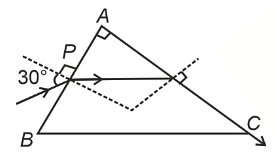
- A light ray enters through a right angled prism at point P with the angle of incidence 30° as shown in figure. It travels through the prism parallel to its base BC and emerges along the face AC. The refractive index of the prism is :
- NEET (UG) - 2024
- Physics
- Refraction Through A Prism
- A laser beam of wavelength 500 nm and power 5 mW strikes normally on a perfectly reflecting surface of area 1 mm\(^2\) of a body. It rebounds back from the surface. Find the force exerted by the laser beam on the body.
- CBSE Class XII - 2025
- Physics
- Refraction Through A Prism
- A ray of light is incident on face AB of a prism ABC with angle of prism \( A \) and emerges out from face AC. The prism is set in the position of minimum deviation with angle of deviation \( \delta \). Find: \begin{enumerate} \item the angle of incidence and \item the angle of refraction on face AB. \end{enumerate}
- CBSE Class XII - 2025
- Physics
- Refraction Through A Prism
- Find the angle of deviation produced by the prism.
- CBSE Class XII - 2025
- Physics
- Refraction Through A Prism
- Want to practice more? Try solving extra ecology questions todayView All Questions

