Moment of Inertia (M.I.) of four bodies having same mass ‘M‘ and radius ‘2R‘ are as follows:
I1 = M.I. of solid sphere about its diameter
I2 = M.I. of solid cylinder about its axis
I3 = M.I. of solid circular disc about its diameter.
I4 = M.I. of thin circular ring about its diameter
If 2(I2 + I3) + I4 = x⋅ I1 then the value of x will be ______.
Moment of Inertia (M.I.) of four bodies having same mass ‘M‘ and radius ‘2R‘ are as follows:
I1 = M.I. of solid sphere about its diameter
I2 = M.I. of solid cylinder about its axis
I3 = M.I. of solid circular disc about its diameter.
I4 = M.I. of thin circular ring about its diameter
If 2(I2 + I3) + I4 = x⋅ I1 then the value of x will be ______.
Correct Answer: 5
Solution and Explanation
To solve the problem, we must calculate the moment of inertia (M.I.) for each given body and use them in the provided equation: 2(I2 + I3) + I4 = x ⋅ I1.
Step 1: Calculate I1
The moment of inertia of a solid sphere about its diameter is given by: I1 = (2/5)MR2, where M is the mass and R is the radius. Since the radius here is 2R, then I1 = (2/5)M(2R)2 = (8/5)MR2.
Step 2: Calculate I2
The moment of inertia of a solid cylinder about its axis is: I2 = (1/2)MR2. For radius 2R, I2 = (1/2)M(2R)2 = 2MR2.
Step 3: Calculate I3
The moment of inertia of a solid circular disc about its diameter is: I3 = (1/4)MR2 + (1/12)Mh2. Assuming negligible height, I3 ≤ (1/4)M(2R)2 = MR2.
Step 4: Calculate I4
The moment of inertia of a thin circular ring about its diameter is: I4 = (1/2)MR2. Hence, for radius 2R, I4 = (1/2)M(2R)2 = 2MR2.
Step 5: Formulate equation
Plug the calculated values into the given equation:
2(I2 + I3) + I4 = x ⋅ I1
Substitute the values:
2(2MR2 + MR2) + 2MR2 = x ⋅ (8/5)MR2
Simplify the left side:
2(3MR2) + 2MR2 = x ⋅ (8/5)MR2
6MR2 + 2MR2 = x ⋅ (8/5)MR2
8MR2 = x ⋅ (8/5)MR2
Cancel MR2 from both sides:
8 = x ⋅ (8/5)
Multiply both sides by 5/8 to isolate x:
x = 8 ⋅ (5/8) = 5
Conclusion:
The value of x is 5, falling within the expected range of 5 to 5.
Top Questions on Centre of mass
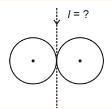
- Two solid spheres each of mass 2 kg and radius 75 cm are arranged as shown. Find MOI of the system about the given axis.
- JEE Main - 2024
- Physics
- Centre of mass
- Three blocks A, B and C are pulled on a horizontal smooth surface by a force of 80 N as shown in figure

The tensions T1 and T2 in the string are respectively:- JEE Main - 2024
- Physics
- Centre of mass
Find the value of m if \(M = 10\) \(kg\). All the surfaces are rough.
- JEE Main - 2024
- Physics
- Centre of mass
A non-uniform bar of weight W is suspended at rest by two strings of negligible weight as shown in Fig.6.33. The angles made by the strings with the vertical are 36.9° and 53.1° respectively. The bar is 2 m long. Calculate the distance d of the centre of gravity of the bar from its left end.

- CBSE Class XI
- Physics
- Centre of mass
- Want to practice more? Try solving extra ecology questions todayView All Questions
