Question:medium
Match List I with List II
List I List II A 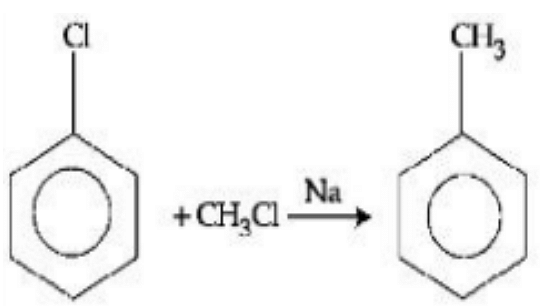
I Fittig reaction B 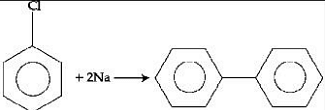
II Wurtz Fittig reaction C 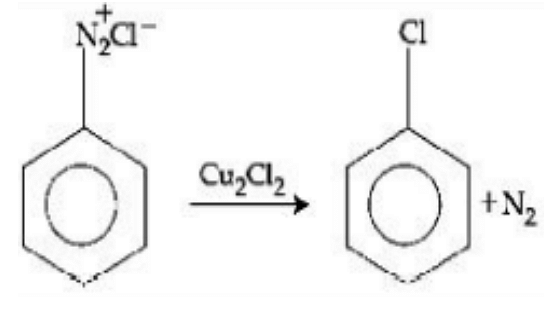
III Finkelstein reaction D \(C_{2}H_{5}CI + NaI \rightarrow C_{2}H_{5}I + NaCl\) IV Sandmeyer reaction
Choose the correct answer from the options given below:
Match List I with List II
| List I | List II | ||
| A | | I | Fittig reaction |
| B | | II | Wurtz Fittig reaction |
| C | | III | Finkelstein reaction |
| D | \(C_{2}H_{5}CI + NaI \rightarrow C_{2}H_{5}I + NaCl\) | IV | Sandmeyer reaction |
Choose the correct answer from the options given below:
Updated On: Apr 1, 2026
- A - III, B - II, C - IV, D - I
- A - II, B - I, C - IV, D - III
- A - IV, B - II, C - III, D - I
- A - II, B - I, C - III, D - IV
Show Solution
The Correct Option is B
Solution and Explanation
To correctly match List I with List II, we must understand the reactions represented by the chemical equations and their common names.
- Analyzing List I:
- Image A: This reaction involves the formation of a compound by combining benzene (phenyl group) with an alkyl group in the presence of sodium. This is a characteristic of the Wurtz Fittig reaction.
- Image B: This reaction shows the coupling of two chlorobenzene molecules with the help of sodium, leading to the formation of biphenyl. Such a reaction is known as the Fittig reaction.
- Image C: This reaction involves the replacement of a diazonium group with a chlorine atom using copper(I) chloride (Cu2Cl2). This is known as a Sandmeyer reaction.
- Equation D: The equation \(C_{2}H_{5}Cl + NaI \rightarrow C_{2}H_{5}I + NaCl\) represents the Finkelstein reaction, which involves halogen exchange facilitated by sodium iodide.
Now, let's match each correctly from List I to List II:
- A - II: Matches with the Wurtz Fittig reaction.
- B - I: Matches with the Fittig reaction.
- C - IV: Matches with the Sandmeyer reaction.
- D - III: Matches with the Finkelstein reaction.
Therefore, the correct answer is: A - II, B - I, C - IV, D - III.
Was this answer helpful?
2
Top Questions on Haloalkanes and Haloarenes
- What is the preliminary test for nanoparticles?
- MHT CET - 2024
- Chemistry
- Haloalkanes and Haloarenes
What is the IUPAC name of the given haloarene?

- MHT CET - 2024
- Chemistry
- Haloalkanes and Haloarenes
- Which compound gives white precipitate with AgNO$_3$ in ethanol?
- MHT CET - 2025
- Chemistry
- Haloalkanes and Haloarenes
- Which of the following is most reactive towards nucleophilic substitution?
- MHT CET - 2025
- Chemistry
- Haloalkanes and Haloarenes
- Want to practice more? Try solving extra ecology questions todayView All Questions
