Question:medium
Let \( \mathbf{a} \) and \( \mathbf{b} \) be two unit vectors such that the angle between them is \( \frac{\pi}{3} \). If \( \lambda \mathbf{a} + 2 \mathbf{b} \) and \( 3 \mathbf{a} - \lambda \mathbf{b} \) are perpendicular to each other, then the number of values of \( \lambda \) in \( [-1, 3] \) is:
Let \( \mathbf{a} \) and \( \mathbf{b} \) be two unit vectors such that the angle between them is \( \frac{\pi}{3} \). If \( \lambda \mathbf{a} + 2 \mathbf{b} \) and \( 3 \mathbf{a} - \lambda \mathbf{b} \) are perpendicular to each other, then the number of values of \( \lambda \) in \( [-1, 3] \) is:
Show Hint
When solving for the number of values of \( \lambda \) in vector problems:
- Focus on vector dot products to find perpendicularity conditions (i.e., dot product equals zero).
- Set up equations using the given conditions (like the angle between vectors and perpendicularity), and solve the resulting quadratic.
Updated On: Jan 14, 2026
- \( 2 \)
- \( 0 \)
- \( 3 \)
- \( 1 \)
Show Solution
The Correct Option is B
Solution and Explanation
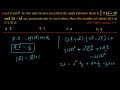
Given that \( \mathbf{a} \) and \( \mathbf{b} \) are unit vectors with an angle of \( \frac{\pi}{3} \) between them, their dot product is \( \mathbf{a} \cdot \mathbf{b} = \cos\left(\frac{\pi}{3}\right) = \frac{1}{2} \). For the vectors \( \lambda \mathbf{a} + 2 \mathbf{b} \) and \( 3 \mathbf{a} - \lambda \mathbf{b} \) to be perpendicular, their dot product must equal zero: \( (\lambda \mathbf{a} + 2 \mathbf{b}) \cdot (3 \mathbf{a} - \lambda \mathbf{b}) = 0 \). Expanding this expression yields \( \lambda \cdot 3 + 2 \cdot (-\lambda) \cdot \frac{1}{2} = 0 \). Solving this equation for \( \lambda \) results in \( \lambda = 0 \). Thus, there is only one possible value for \( \lambda \).
Was this answer helpful?
0
Learn with videos:
Top Questions on Geometry and Vectors
- Let the arc AC of a circle subtend a right angle at the center O. If the point B on the arc AC divides the arc AC such that: \[ \frac{\text{length of arc AB}}{\text{length of arc BC}} = \frac{1}{5} \] and \[ \overrightarrow{OC} = \alpha \overrightarrow{OA} + \beta \overrightarrow{OB}, \] then \( \alpha = \sqrt{2} (\sqrt{3}-1) \beta \) is equal to:
- JEE Main - 2025
- Mathematics
- Geometry and Vectors
- Let P be the foot of the perpendicular from the point \( Q(10,-3,-1) \) on the line: \[ \frac{x-3}{7} = \frac{y-2}{-1} = \frac{z+1}{-2}. \] Then the area of the right-angled triangle PQR, where R is the point \( (3,-2,1) \), is:
- JEE Main - 2025
- Mathematics
- Geometry and Vectors
- Let \( \frac{\overline{z} - i}{z - i} = \frac{1}{3}, \, z \in \mathbb{C} \), be the equation of a circle with center at \( C \). If the area of the triangle, whose vertices are at the points \( (0, 0), C \) and \( (\alpha, 0) \), is 11 square units, then \( \alpha^2 \) equals:
- JEE Main - 2025
- Mathematics
- Geometry and Vectors
- Let the area of a triangle \( \triangle PQR \) with vertices \( P(5, 4) \), \( Q(-2, 4) \), and \( R(a, b) \) be 35 square units. If its orthocenter and centroid are \( O(2, \frac{14}{5}) \) and \( C(c, d) \) respectively, then \( c + 2d \) is equal to:
- JEE Main - 2025
- Mathematics
- Geometry and Vectors
- Want to practice more? Try solving extra ecology questions todayView All Questions
