Question:medium
Let \(C_1\) and \(C_2\) be concentric circles such that the diameter of \(C_1\) is 2 cm longer than that of \(C_2\). If a chord of \(C_1\) has length 6 cm and is a tangent to \(C_2\), then the diameter, in cm, of \(C_1\) is
[This Question was asked as TITA]
Let \(C_1\) and \(C_2\) be concentric circles such that the diameter of \(C_1\) is 2 cm longer than that of \(C_2\). If a chord of \(C_1\) has length 6 cm and is a tangent to \(C_2\), then the diameter, in cm, of \(C_1\) is
[This Question was asked as TITA]
[This Question was asked as TITA]
Updated On: Jan 15, 2026
- 10 cm
- 12 cm
- 15 cm
- 18 cm
Show Solution
The Correct Option is A
Solution and Explanation
Given: \( d + 2 = D \Rightarrow r + 1 = R \)
In the provided diagram, the small circle's radius is denoted by \( r \). Consequently:
- \( OT = r \) represents the radius of the smaller circle.
- \( OB = r + 1 = R \) represents the radius of the larger circle.
- The line segment AB is tangent to the smaller circle at point T, meaning it is perpendicular to the radius OT.
- Thus, \( OT \perp AB \).
- Furthermore, OT bisects AB, resulting in \( TB = \frac{6}{2} = 3 \, \text{cm} \).
Applying the Pythagorean theorem to the right-angled triangle \( \triangle OTB \):
\[ OT^2 + TB^2 = OB^2 \]
Substituting the known values:
\[ r^2 + 3^2 = (r + 1)^2 \]
Expanding the equation:
\[ r^2 + 9 = r^2 + 2r + 1 \]
Simplifying by canceling \( r^2 \) from both sides:
\[ 9 = 2r + 1 \Rightarrow 2r = 8 \Rightarrow r = 4 \]
With \( r = 4 \), the radius of the larger circle is \( R = r + 1 = 5 \).
The diameter of the larger circle is calculated as: \[ D = 2R = 2 \times 5 = \mathbf{10 \, \text{cm}} \]
Correct option: (A) 10 cm
Was this answer helpful?
0
Top Questions on Triangles, Circles & Quadrilaterals
- Let \(ΔABC\) be an isosceles triangle such that \(AB\) and \(AC\) are of equal length. \(AD\) is the altitude from \(A\) on \(BC\) and \(BE\) is the altitude from \(B\) on \(AC\) . If \(AD\) and \(BE\) intersect at \(O\) such that \(∠AOB =105\degree\) , then \(\frac{AD}{BE}\) equals
- CAT - 2023
- Quantitative Aptitude
- Triangles, Circles & Quadrilaterals
- A rectangle with the largest possible area is drawn inside a semicircle of radius 2 cm. Then, the ratio of the lengths of the largest to the smallest side of this rectangle is
- CAT - 2023
- Quantitative Aptitude
- Triangles, Circles & Quadrilaterals
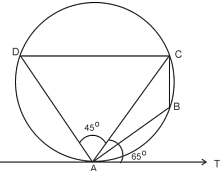
- In the given figure, if \(∠CAT = 65°\) and \(∠CAD = 45°\), what is the value of \(∠ACD?\) (Figure not drawn to scale)
- IBSAT
- Quantitative Aptitude
- Triangles, Circles & Quadrilaterals
- Gopi constructed a right-angled triangle. By modifying the dimensions of first triangle, he drew another triangle. The modifications are - the largest side is increased by 5 cm, the smallest side is doubled and the third side is increased by 50%. If the triangle formed with these new dimensions has equal angles, then what is the perimeter of the new triangle?
- IBSAT
- Quantitative Aptitude
- Triangles, Circles & Quadrilaterals
- Want to practice more? Try solving extra ecology questions todayView All Questions