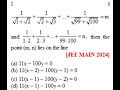
If \(\frac{1}{\sqrt{1} + \sqrt{2}} + \frac{1}{\sqrt{2} + \sqrt{3}} + \dots + \frac{1}{\sqrt{99} + \sqrt{100}} = m\) and \(\frac{1}{1 \cdot 2} + \frac{1}{2 \cdot 3} + \dots + \frac{1}{99 \cdot 100} = n,\) then the point \( (m, n) \) lies on the line
- 11(x – 1) – 100(y – 2) = 0
- 11(x – 2) – 100(y – 1) = 0
- 11(x – 1) – 100y = 0
- 11x – 100y = 0
The Correct Option is D
Solution and Explanation
Let \( m \) be the sum:
\[ \frac{1}{\sqrt{1} + \sqrt{2}} + \frac{1}{\sqrt{2} + \sqrt{3}} + \cdots + \frac{1}{\sqrt{99} + \sqrt{100}} = m \]
Rationalizing each term yields:
\[ \frac{\sqrt{1} - \sqrt{2}}{-1} + \frac{\sqrt{2} - \sqrt{3}}{-1} + \cdots + \frac{\sqrt{99} - \sqrt{100}}{-1} = m \]
This sum telescopes to:
\[ \sqrt{100} - \sqrt{1} = m \implies m = 10 - 1 = 9 \]
Let \( n \) be the sum:
\[ \frac{1}{1 \cdot 2} + \frac{1}{2 \cdot 3} + \cdots + \frac{1}{99 \cdot 100} = n \]
Rewriting each term using partial fractions:
\[ \left(1 - \frac{1}{2}\right) + \left(\frac{1}{2} - \frac{1}{3}\right) + \cdots + \left(\frac{1}{99} - \frac{1}{100}\right) = n \]
This sum telescopes to:
\[ 1 - \frac{1}{100} = n \implies n = \frac{99}{100} \]
Therefore, \((m, n) = (9, \frac{99}{100})\).
Substitute these values into the equation \( 11x - 100y \):
\[ 11(9) - 100\left(\frac{99}{100}\right) = 99 - 99 = 0 \]
Correct Answer: option (4) \( 11x - 100y = 0 \)
Learn with videos:
Top Questions on Sequence and series
- If the sum of the first \( n \) terms of an arithmetic progression (AP) is given by \( S_n = 3n^2 + 2n \), find the 4th term of the AP.
- MHT CET - 2025
- Mathematics
- Sequence and series
- The sum of the infinite geometric series $ S = \frac{a}{1-r} $ is 24, and the sum of the first three terms is 21. Find $ a $ and $ r $.
- BITSAT - 2025
- Mathematics
- Sequence and series
- Find the sum of 2 + \(\frac{1}{2}\)+ \(\frac{1}{3}\) + \(\frac{1}{4}\) + \(\frac{1}{8}\)+ \(\frac{1}{9}\) + \(\frac{1}{16}\) +\(\frac{1}{27}\).
- GATE AR
- Data Science and Artificial Intelligence
- Sequence and series
- \(3, a, b, c\) are in Ap and \(3, a-1, b+1, c+9\) are in GP. Then AM of \(a, b, c\) is
- JEE Main - 2024
- Mathematics
- Sequence and series
- Want to practice more? Try solving extra ecology questions todayView All Questions
