From an interior point of an equilateral triangle, perpendiculars are drawn on all three sides. The sum of the lengths of the three perpendiculars is s. Then the area of the triangle is
- \(\frac{\sqrt{3}s^2}{2}\)
- \(\frac{s^2}{\sqrt{3}}\)
- \(\frac{2s^2}{\sqrt3}\)
- \(\frac{s^2}{2\sqrt3}\)
The Correct Option is B
Solution and Explanation

Let \( D, E, F \) denote the feet of perpendiculars from point \( P \) within equilateral triangle \( \triangle ABC \) to sides \( BC, CA, AB \), respectively.
Let the sum of these perpendiculars be \( s \): \[ PD + PE + PF = s \]
Step 1: Express Area as a sum of smaller triangle areas
The area of \( \triangle ABC \) can be expressed as the sum of the areas of \( \triangle PBC, \triangle PCA, \) and \( \triangle PAB \): \[ \text{Area} = \frac{1}{2} \cdot BC \cdot PD + \frac{1}{2} \cdot AC \cdot PE + \frac{1}{2} \cdot AB \cdot PF \] Given that \( AB = BC = AC \), this simplifies to: \[ \text{Area} = \frac{1}{2} \cdot AB \cdot (PD + PE + PF) = \frac{1}{2} \cdot AB \cdot s \tag{1} \]
Step 2: Apply the standard area formula for an equilateral triangle
The area of an equilateral triangle with side length \( AB \) is: \[ \text{Area} = \frac{\sqrt{3}}{4} \cdot AB^2 \] Equating this with equation (1): \[ \frac{\sqrt{3}}{4} AB^2 = \frac{1}{2} AB \cdot s \] Dividing both sides by \( AB \) (since \( AB eq 0 \)): \[ \frac{\sqrt{3}}{4} AB = \frac{1}{2} s \Rightarrow AB = \frac{2s}{\sqrt{3}} \]
Step 3: Substitute the derived side length into equation (1)
Substitute the expression for \( AB \) back into equation (1): \[ \text{Area} = \frac{1}{2} \cdot \left( \frac{2s}{\sqrt{3}} \right) \cdot s = \frac{s^2}{\sqrt{3}} \]
Final Answer:
✅ The area of the equilateral triangle, in terms of the sum \( s \) of the perpendiculars from an interior point to its sides, is: \[ \boxed{\frac{s^2}{\sqrt{3}}} \] Thus, the correct option is: (B)
Top Questions on Triangles, Circles & Quadrilaterals
- Let \(ΔABC\) be an isosceles triangle such that \(AB\) and \(AC\) are of equal length. \(AD\) is the altitude from \(A\) on \(BC\) and \(BE\) is the altitude from \(B\) on \(AC\) . If \(AD\) and \(BE\) intersect at \(O\) such that \(∠AOB =105\degree\) , then \(\frac{AD}{BE}\) equals
- CAT - 2023
- Quantitative Aptitude
- Triangles, Circles & Quadrilaterals
- A rectangle with the largest possible area is drawn inside a semicircle of radius 2 cm. Then, the ratio of the lengths of the largest to the smallest side of this rectangle is
- CAT - 2023
- Quantitative Aptitude
- Triangles, Circles & Quadrilaterals
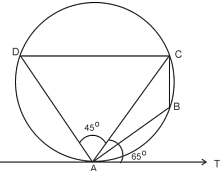
- In the given figure, if \(∠CAT = 65°\) and \(∠CAD = 45°\), what is the value of \(∠ACD?\) (Figure not drawn to scale)
- IBSAT
- Quantitative Aptitude
- Triangles, Circles & Quadrilaterals
- Gopi constructed a right-angled triangle. By modifying the dimensions of first triangle, he drew another triangle. The modifications are - the largest side is increased by 5 cm, the smallest side is doubled and the third side is increased by 50%. If the triangle formed with these new dimensions has equal angles, then what is the perimeter of the new triangle?
- IBSAT
- Quantitative Aptitude
- Triangles, Circles & Quadrilaterals
- Want to practice more? Try solving extra ecology questions todayView All Questions