Question:medium
For forces are acting at a point P in equilibrium as shown in the figure. The ratio of force F1 to F2 is 1 : x where x =___.
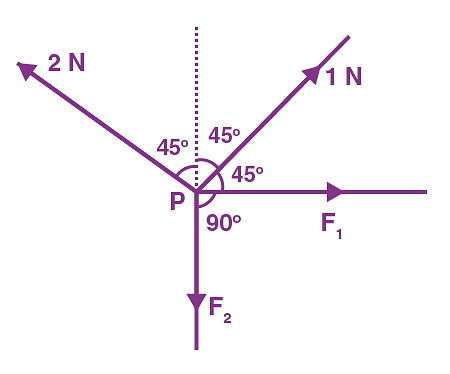
For forces are acting at a point P in equilibrium as shown in the figure. The ratio of force F1 to F2 is 1 : x where x =___.
Updated On: Mar 20, 2026
Show Solution
Correct Answer: 3
Solution and Explanation
To find the ratio of force F1 to F2 when the forces are in equilibrium, we apply the equilibrium conditions. Since P is in equilibrium, the sum of horizontal and vertical components of forces must be zero.
Horizontal Components:
Let F1 be the force on the horizontal axis.
Let F1 be the force on the horizontal axis.
The horizontal components of the forces are:
F1 to the right, 1 N × cos(45°) to the right, and 2 N × cos(45°) to the left.
To satisfy equilibrium: F1 + 1cos(45°) = 2cos(45°)
F1 to the right, 1 N × cos(45°) to the right, and 2 N × cos(45°) to the left.
To satisfy equilibrium: F1 + 1cos(45°) = 2cos(45°)
Using cos(45°) = 1/√2:
F1 + 1/√2 = 2/√2
F1 = (2/√2) - (1/√2) = 1/√2
F1 = (2/√2) - (1/√2) = 1/√2
Vertical Components:
The vertical components are:
The vertical components are:
F2 acting downward, 1 N × sin(45°) acting upward, and 2 N × sin(45°) acting up.
For equilibrium: F2 = 1sin(45°) + 2sin(45°)
For equilibrium: F2 = 1sin(45°) + 2sin(45°)
Using sin(45°) = 1/√2:
F2 = (1/√2) + (2/√2) = 3/√2
Ratio of F1 to F2:
F1:F2 = (1/√2):(3/√2) = 1:3
The ratio of F1 to F2 is 1:3, which is within the given range of (3, 3).
Was this answer helpful?
1
Top Questions on torque
- A uniform circular disc of mass 2 kg and radius 0.5 m is mounted on a frictionless axle. A force of 4 N is applied tangentially at the rim for 2 seconds. Find the angular velocity acquired by the disc at the end of 2 seconds.
- MHT CET - 2025
- Physics
- torque
- A uniform circular disc of mass 2 kg and radius 0.5 m is mounted on a frictionless axle. A force of 4 N is applied tangentially at the rim for 2 seconds. Find the angular velocity acquired by the disc at the end of 2 seconds.
- MHT CET - 2025
- Physics
- torque
- A uniform circular disc of mass 2 kg and radius 0.5 m is mounted on a frictionless axle. A force of 4 N is applied tangentially at the rim for 2 seconds. Find the angular velocity acquired by the disc at the end of 2 seconds.
- MHT CET - 2025
- Physics
- torque
- A uniform magnetic field of \( 2 \times 10^{-3} \, \text{T} \) acts along positive Y-direction. A rectangular loop of sides 20 cm and 10 cm with current of 5 A is in the Y-Z plane. The current is in anticlockwise sense with reference to the negative X-axis. Magnitude and direction of the torque is:
- JEE Main - 2024
- Physics
- torque
- Want to practice more? Try solving extra ecology questions todayView All Questions
