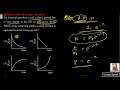
For bacterial growth in a cell culture, growth law is very similar to the law of radioactive decay. Which of the following graphs is most suitable to represent bacterial colony growth? Where \( N \) - Number of Bacteria at any time, \( N_0 \) - Initial number of Bacteria.
Show Hint


The Correct Option is A
Solution and Explanation
To determine the optimal graph for depicting bacterial colony growth, it is necessary to examine the governing principles of bacterial proliferation:
In a simplified form, the quantity of bacteria \( N \) at a given time \( t \) can be quantified as \( N(t) = N_0 \times e^{kt} \). Here, \( N_0 \) signifies the initial bacterial count, and \( k \) represents the constant growth rate. This mathematical expression aligns with the exponential growth model, analogous to the principles observed in radioactive decay.
An exponential growth model of this nature is most effectively visualized through a graph characterized by:
- The vertical axis (y-axis), representing the bacterial population, \( N(t) \).
- The horizontal axis (x-axis), denoting the passage of time, \( t \).
- A curved line illustrating a steepening rate of increase as time advances.
The representation of the appropriate graph among the available selections is as follows:

This particular graph exhibits an exponential curve, a characteristic signature of bacterial growth over time, assuming an environment with abundant resources.
Consequently, this graph accurately portrays bacterial colony expansion governed by exponential growth dynamics, comparable to radioactive decay. The bacterial population experiences an exponential surge with increasing time.
Learn with videos:
Top Questions on Radioactive Decay
- A radioactive nucleus decays as follows: \[ X \to X_1 \to X_2 \to X_3 \to X_4 \] If the mass number and atomic number of \( X_4 \) are 172 and 69 respectively, the mass number and atomic number of \( X \) are:
- WBJEE - 2025
- Physics
- Radioactive Decay
- A radioactive nucleus \( n_2 \) has 3 times the decay constant as compared to the decay constant of another radioactive nucleus \( n_1 \). If the initial number of both nuclei are the same, what is the ratio of the number of nuclei of \( n_2 \) to the number of nuclei of \( n_1 \), after one half-life of \( n_1 \)?
- JEE Main - 2025
- Physics
- Radioactive Decay
- A radioactive material P first decays into Q and then Q decays to non-radioactive material R. Which of the following figure represents time dependent mass of P, Q and R?
- JEE Main - 2025
- Physics
- Radioactive Decay
- The half-life period of a radioactive element is 150 days. After 600 days, 1 gm of the element will be reduced to:
- JEECUP - 2024
- Chemistry
- Radioactive Decay
- Want to practice more? Try solving extra ecology questions todayView All Questions
