Question:medium
Eight identical spherical liquid drops, each falling with a terminal velocity $v$, coalesce to form a single large drop. The terminal velocity of the new large drop is:
Eight identical spherical liquid drops, each falling with a terminal velocity $v$, coalesce to form a single large drop. The terminal velocity of the new large drop is:
Show Hint
When identical drops combine:
\[
R = n^{1/3} r
\]
and since terminal velocity follows:
\[
v \propto r^2
\]
therefore:
\[
v' = n^{2/3} v
\]
Updated On: Aug 15, 2026
- $2v$
- $4v$
- $8v$
- $16v$
Show Solution
The Correct Option is B
Solution and Explanation
Step 1: Understanding the Concept:
This problem investigates the physics of fluid dynamics, specifically focusing on terminal velocity and the conservation of mass/volume during the coalescence of liquid droplets.
Terminal velocity is reached when an object falling through a viscous fluid experiences zero net force.
This occurs because the downward gravitational force is perfectly balanced by the upward buoyancy and the viscous drag force (Stokes' Law).
When multiple small drops merge into one large drop, the total volume remains constant, but the surface area changes.
The change in radius directly affects the terminal velocity because the gravitational force (proportional to mass/volume, hence \(r^3\)) and the drag force (proportional to velocity and radius, \(rv\)) scale differently.
Key Formula or Approach:
According to Stokes' Law, the terminal velocity \(v\) of a spherical object of radius \(r\) is given by:
\[ v = \frac{2r^2 (\rho - \sigma) g}{9\eta} \] Where:
- \(\rho\) is the density of the drop.
- \(\sigma\) is the density of the medium.
- \(g\) is the acceleration due to gravity.
- \(\eta\) is the coefficient of viscosity.
From this expression, we see that for the same liquid and medium, the terminal velocity is directly proportional to the square of the radius:
\[ v \propto r^2 \] Step 2: Detailed Explanation:
Let the radius of each of the eight identical small drops be \(r\).
Let the radius of the resulting large drop be \(R\).
1. Volume Conservation:
The volume of 8 small drops equals the volume of the single large drop.
\[ 8 \times \left( \frac{4}{3}\pi r^3 \right) = \frac{4}{3}\pi R^3 \]
By canceling out common terms \(\frac{4}{3}\pi\), we get:
\[ 8r^3 = R^3 \]
Taking the cube root on both sides:
\[ R = \sqrt[3]{8r^3} = 2r \]
This tells us the radius of the new drop is exactly double the radius of the individual small drops.
2. Relating Terminal Velocities:
Let \(v\) be the terminal velocity of the small drop and \(V'\) be the terminal velocity of the large drop.
Using the proportionality \(v \propto r^2\):
\[ \frac{V'}{v} = \left( \frac{R}{r} \right)^2 \]
Substitute \(R = 2r\) into the ratio:
\[ \frac{V'}{v} = \left( \frac{2r}{r} \right)^2 \]
\[ \frac{V'}{v} = (2)^2 = 4 \]
\[ V' = 4v \]
The increase in terminal velocity happens because the mass of the drop increases by a factor of 8 (increasing the downward pull), while the drag-related radius only increases by a factor of 2.
This results in a net four-fold increase in the speed required to reach force equilibrium.
Step 3: Final Answer:
The terminal velocity of the new large drop is \(4v\).
This problem investigates the physics of fluid dynamics, specifically focusing on terminal velocity and the conservation of mass/volume during the coalescence of liquid droplets.
Terminal velocity is reached when an object falling through a viscous fluid experiences zero net force.
This occurs because the downward gravitational force is perfectly balanced by the upward buoyancy and the viscous drag force (Stokes' Law).
When multiple small drops merge into one large drop, the total volume remains constant, but the surface area changes.
The change in radius directly affects the terminal velocity because the gravitational force (proportional to mass/volume, hence \(r^3\)) and the drag force (proportional to velocity and radius, \(rv\)) scale differently.
Key Formula or Approach:
According to Stokes' Law, the terminal velocity \(v\) of a spherical object of radius \(r\) is given by:
\[ v = \frac{2r^2 (\rho - \sigma) g}{9\eta} \] Where:
- \(\rho\) is the density of the drop.
- \(\sigma\) is the density of the medium.
- \(g\) is the acceleration due to gravity.
- \(\eta\) is the coefficient of viscosity.
From this expression, we see that for the same liquid and medium, the terminal velocity is directly proportional to the square of the radius:
\[ v \propto r^2 \] Step 2: Detailed Explanation:
Let the radius of each of the eight identical small drops be \(r\).
Let the radius of the resulting large drop be \(R\).
1. Volume Conservation:
The volume of 8 small drops equals the volume of the single large drop.
\[ 8 \times \left( \frac{4}{3}\pi r^3 \right) = \frac{4}{3}\pi R^3 \]
By canceling out common terms \(\frac{4}{3}\pi\), we get:
\[ 8r^3 = R^3 \]
Taking the cube root on both sides:
\[ R = \sqrt[3]{8r^3} = 2r \]
This tells us the radius of the new drop is exactly double the radius of the individual small drops.
2. Relating Terminal Velocities:
Let \(v\) be the terminal velocity of the small drop and \(V'\) be the terminal velocity of the large drop.
Using the proportionality \(v \propto r^2\):
\[ \frac{V'}{v} = \left( \frac{R}{r} \right)^2 \]
Substitute \(R = 2r\) into the ratio:
\[ \frac{V'}{v} = \left( \frac{2r}{r} \right)^2 \]
\[ \frac{V'}{v} = (2)^2 = 4 \]
\[ V' = 4v \]
The increase in terminal velocity happens because the mass of the drop increases by a factor of 8 (increasing the downward pull), while the drag-related radius only increases by a factor of 2.
This results in a net four-fold increase in the speed required to reach force equilibrium.
Step 3: Final Answer:
The terminal velocity of the new large drop is \(4v\).
Was this answer helpful?
1
Top Questions on Viscosity
- An air bubble of diameter 6 mm rises steadily through a solution of density 1750kg / m3 at the rate of 0.35 cm/s. The co-efficient of viscosity of the solution (neglect density of air) is ____Pas (given, g = 10ms-2)
- JEE Main - 2023
- Physics
- Viscosity
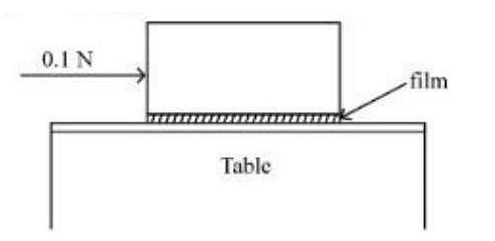
- A metal block of base area \(0.20 \,m^2\) is placed on a table, as shown in figure. A liquid film of thickness \(0.25\, mm\) is inserted between the block and the table. The block is pushed by a horizontal force of 0.1 N and moves with a constant speed. If the viscosity of the liquid is \(5.0×10^{−3}Pl\), the speed of block is ________ \(×10^{−3}m/s\)
- JEE Main - 2023
- Physics
- Viscosity
- The diameter of an air bubble which was initially 2 mm, rises steadily through a solution of density 1750 kg m–3 at the rate of 0.35 cms–1. The coefficient of viscosity of the solution is _______ poise (in nearest integer). (The density of air is negligible).
- JEE Main - 2022
- Physics
- Viscosity
A spherical ball is dropped in a long column of viscous liquid. The speed v of the ball as a function of time t may be best represented by

- BITSAT - 2010
- Physics
- Viscosity
- Want to practice more? Try solving extra ecology questions todayView All Questions